


Hello, fellow lovers of all things green,
Last week, we spoke about sweet peas—and how it is also a term of endearment—which seems like a fun way to start this week’s chat.
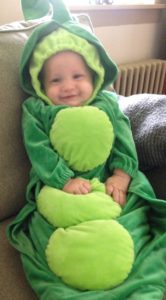
A real-life sweet pea. Grant, the son of associate gardener Rachel, inspired a smile then—and still does today (Grant is now in 5th grade).
“Sweet pea” has long been used affectionately to describe someone sweet or lovely, especially a child or a loved one. And then there’s another garden-variety term of endearment: calling someone “a peach.” Peach came to mean an especially delightful or attractive person by the late 1800s, eventually giving us “she’s a real peach” and “peachy” to mean something especially good or wonderful.
Funny how many of our affectionate names come from things we eat—honey, pumpkin, sweet pea, peach. Maybe there’s something instinctive about connecting those we love with sweetness and nourishment.
The volunteer coordinator for Karen Ann Quinlan Hospice recently noted that a patient’s family member had described a fellow volunteer as “a real peach.” It made me smile and wonder whether young people still use the expression.
Clingstone, Freestone & Fuzzless Peaches
Peaches themselves are fuzzy and tickly on the tongue, though I happen to like the skin—or peel, as most call it. For those who don’t, there’s the fuzzless alternative: nectarines.
I had always associated nectarines with pits that cling fiercely to the flesh, making them less cooperative for a bowl of cut fruit. But I’ve since learned that’s not necessarily so.
Both peaches and nectarines come in clingstone, semi-freestone, and freestone varieties. Freestones are, as the name suggests, much easier to separate from the pit.
For those interested in growing peaches at home, Rutgers lists several varieties suited to home orchards here in Northern New Jersey, including Redhaven, Coralstar, Redkist, Madison, and Contender. Redhaven is a longtime standard, while Contender is a productive freestone with very good flavor. Check with your local Extension office for varieties suited to your neck of the woods.
Several of these varieties also show low susceptibility to bacterial spot—an important distinction because disease resistance doesn’t mean resistance to every disease a peach tree may encounter.
Keeping Fruit Within Reach
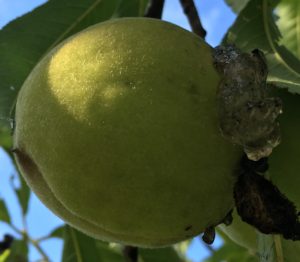
A peach may be within our reach—but squirrels have a knack for getting there first.
Speaking of peaches, I’m working with local clients who have several fruit trees. Many are planted in large barrels on top of their deck, which we’ll be replacing with a natural stone patio. I’m so excited about that, and they are, too.
Some of their fruit trees are Reachables®, an aptly named line of dwarf fruit trees that produce full-sized fruit on smaller trees, making them easier to harvest without a long pole with a basket on the end—a fruit picker or fruit-picking pole. I’m sure many of you have enjoyed visits to pick-your-own orchards and used one yourselves.
Apples and pears are especially well suited to dwarfing rootstocks, while peaches and nectarines can also be maintained at modest heights with thoughtful pruning and training. Keeping fruit within reach makes harvesting easier and makes pruning, thinning, and pest monitoring more manageable.
Though keeping the fruit within our reach also keeps it within reach of squirrels, deer, and other pilferers.
When the Squirrel Gets the Peach
My clients described the single peach growing on their peach tree on the deck. They had watched it develop, anticipating the day it would be ready to pick. Then a squirrel beat them to it. They watched the little fellow hold their precious peach in his paws and eat it all the way down to the pit, rotating it as he went.
Sometimes, despite all our careful tending, the squirrel gets the peach.
“So cute,” they admitted.
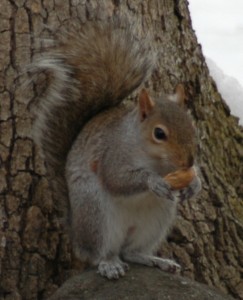
Then he spit out the pit.
“Not only do you eat my fruit, but I have to clean up after you?”
That made me laugh.
It’s nice to share our bounty with wildlife, of course, but those who feed the birds know squirrels can be greedy. Chipmunks, too.
I remember the days when I grew cherry tomatoes in pots on the back patio. Chipmunks would take one bite out of a tomato and leave the rest behind, with several little wounded tomatoes scattered around the patio. Couldn’t they at least finish one before sampling the next? Not so peachy.
So I began harvesting the tomatoes as soon as they reached the mature-green, or gel, stage, when the green skin begins to lighten—or by the breaker stage, when the first blush of mature color appears—and let them finish ripening safely indoors, away from the little pilferers.
Which brings me to another not-so-peachy story.
A Jelly-Like Peach-Tree Dilemma
Joanne of Hope, New Jersey, had a gooey dilemma on her peach trees. Both trees had clear, jelly-like globs on or near the fruit, along with rust-colored goo on some of the branches. One tree had a deep wound at the base of the trunk, yet interestingly, that was the tree producing edible fruit, though the peaches were spotted with grayish freckles.
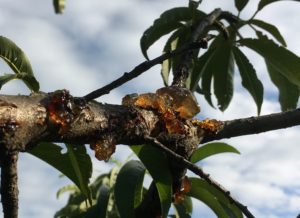
Jelly-like sap on stone fruits is known as gummosis—a symptom that can result from injury, stress, insects, or disease.
Stone fruits such as peaches, nectarines, cherries, and plums sometimes respond to stress or injury by producing a jelly-like sap. The condition, commonly known as gummosis, doesn’t have just one cause.
Physical injury can cause it. So can environmental stress, insects, and disease. Peach tree borers can produce gumming around injured areas, for example, sometimes mixed with bits of bark or frass. (Frass, by the way, is insect poop. In case you didn’t know. :^)
Gummosis & Cytospora Canker
Then there’s Cytospora canker, also known as perennial canker or peach canker. Penn State describes it as an important disease of stone fruits to identify because it can kill young trees while causing older trees to decline gradually.
The fungus gains entry through vulnerable tissue such as bark injuries, pruning cuts, dead shoots, and other damaged areas. At the point of infection, a canker forms and gradually enlarges. Gum oozes from the affected area, and older cankers may develop torn bark and darkened gum.
Once Cytospora becomes established, there isn’t a simple spray that makes it disappear. Management instead centers on removing infected wood when practical and, most importantly, preventing the wounds and stresses that allow disease to take hold.
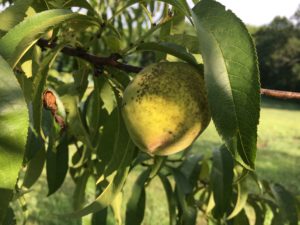
The grayish freckles on Joanne’s peaches seem like peach scab, another fungal disease of stone fruits.
Back to Joanne’s freckled fruit. Clearly, her peach trees were dealing with multiple issues. And isn’t that often how it goes?
When One Stress Leads to Another
A tree weakened by drought becomes more vulnerable to injury. An injury provides an entry point for disease. One stress compounds another until suddenly we’re looking at the symptoms and wondering how everything went wrong at once.
People aren’t so different.
We can’t protect ourselves—or our gardens—from every drought, wound, pest, disappointment, or hungry squirrel that comes along. But we can build resilience.
For fruit trees, that means preventing mower and string-trimmer injuries around trunks, providing water during prolonged dry spells, pruning appropriately, removing dead or damaged wood, and giving trees the conditions they need to thrive.
For ourselves, it means much the same thing: nourish our roots, pay attention to wounds rather than pretending they aren’t there, accept help when it’s needed, remove what is no longer healthy, and when life has been especially dry, take time to replenish. Because stress doesn’t always announce itself loudly, it can show up as a little ooze from a wound we thought had healed.
And despite all our careful tending, there are times when the squirrel gets the peach.
While we can’t prevent every loss, we can remember that there will be other peaches, other seasons, and other sweetness still to come.
And when it does, savor it—preferably before the squirrel does.
 Prefer to Listen?
This story is also a feature in this week’s episode of Garden Dilemmas, Delights & Discoveries, with additional reflections from the screen porch:
What Lies Beneath
And speaking of that reflection, it occurs to me that we had a similar gummy dilemma in the spring with a weeping cherry tree. We spoke about it in When a Weeping Cherry “Bleeds”: What Lies Beneath. My client’s cherry tree had gummosis, too, though it didn’t form the jelly-like globs Joanne found on her peach trees.

A weeping cherry dilemma earlier this year offered another example of gummosis—and another reason to look beyond the visible symptom.
Something else from that story feels especially relevant again today.
Two weeping cherry trees had declined in the same spot, suggesting something might be happening underground—compacted soil, poor drainage, root impediments, or another lingering issue beneath the surface.
That’s a Garden of Life lesson, too, isn’t it?
When we find ourselves facing the same difficulty again and again, perhaps it’s worth looking beyond what we can see. What’s happening beneath the surface? Are there old wounds, stresses, or patterns affecting what’s trying to grow aboveground—and in our hearts?

Even as seasons change and leaves let go, life continues to unfold.
Trees tell their stories through their leaves, their bark, their roots, and sometimes through the wounds that ooze. We tell our stories in different ways, but perhaps our struggles are messengers, too.
I’ve learned that tending what’s beneath the surface doesn’t mean having all the answers. It means accepting what is, asking for help, going with the flow, and trusting the unfolding—even when we can’t yet see where it’s leading.
That’s part of what my brother Bill’s beautiful Lesson of the Leaf continues to teach me: we aren’t alone in this world. We belong to it. And there is comfort in knowing that even as seasons change and leaves let go, life continues to unfold. Thank you for joining me on this journey.
Namaste, Mary
Garden Dilemmas? AskMaryStone@gmail.com or tune in on your favorite Podcast App.
Related Stories & Episodes you’ll enjoy:
It’s Not Too Late to Plant Again — Blog Post
Ep 266 — It’s Not Too Late to Plant Again, Sweet Pea
When a Weeping Cherry “Bleeds”: What Lies Beneath — Blog Post
Ep 250 — Weeping Cherry Dilemmas: Trees Tell a Story
Ripening Fall Tomato Hand-me-Downs – Blog Post
Ep 133. Ripening Fall Tomato Hand-me-Downs


