


Hello, fellow lovers of all things green,
When a weeping cherry tree begins to “bleed,” it reveals a deeper story—about stress, soil, and what lies beneath—and a reminder from the garden about where we’re truly meant to grow.
🌿 Understanding the Weeping Cherry

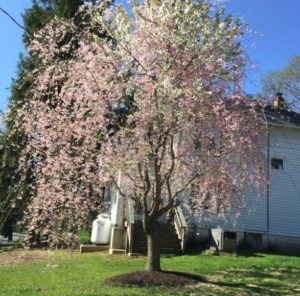
A weeping cherry in spring—beauty that reminds us of what’s possible when a tree is well-situated and thriving.
While visiting a longtime client in Piscataway, I came upon a brown, syrupy wound oozing halfway up the trunk of a weeping cherry tree, just below the graft. It hadn’t been there last year.
Weeping cherry trees are often top-grafted. The weeping portion (the scion) is grafted onto a straight trunk (the rootstock), creating that graceful, umbrella-like form. The commonly sold Weeping Higan Flowering Cherry (Prunus subhirtella ‘Pendula’) is actually a combination of hardy Sargent Cherry roots, a Yoshino Cherry trunk, and a Higan Cherry canopy. The graft is typically just below the crown, where the tree’s branching begins.
Planting Matters More Than We Think
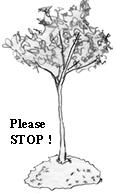
A “mulch volcano” traps moisture and invites decay—please stop!
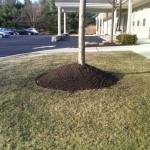
Mulch piled against the trunk can lead to rot, disease, and long-term stress for the tree.
We planted the weeping cherry to replace another that failed in the same spot, likely because it was planted incorrectly. You’ve seen it: the all-too-common “mulch volcano.” Not only unsightly, but it’s also harmful. Excess mulch piled against the trunk holds moisture, inviting rot, insects, and disease.
Sometimes what appears to be a mulch volcano is actually a tree planted too shallowly. Sadly, I’ve even seen professionals plant this way. Root girdling often follows, as roots circle the trunk and constrict it, cutting off water and nutrients. It’s like wearing something too tight—everything gets restricted. Roots wrap inward rather than outward, slowly suffocating the plant.
When planting, give your tree (or shrub or perennial) the right start. Dig a hole two to three times as wide as the root ball, but no deeper. Amend with organic matter, firming the soil slightly to remove air pockets, and avoid fertilizing at planting, as it can increase stress. Once planted, apply 2 to 3 inches of natural hardwood mulch or leaf mold (my preference), keeping it away from the trunk.
When Trees Send a Signal

Amber sap, known as gummosis, is oozing from a wound—one of the tree’s ways of signaling stress.
The oozing sap I noticed is called gummosis—a tree’s distress signal. Trees don’t “bleed” without reason. Often, the cause is a canker, bacterial or fungal, that enters through a wound from a pruning cut, winter injury, or even a nick from a string trimmer. Pathogens are opportunists, waiting for an opening.
I can’t help but feel how familiar that is. As I continue my journey through a difficult life change, it feels like an open wound at times. The garden has a way of mirroring those moments, reminding us that stress often shows itself not all at once but in subtle signals that ask for attention.
When the Story Deepens
Now here’s where the story takes a turn. Recall how we spoke about newly planted plants tend to sleep the first year, creep the second, then leap the third. We installed the tree only three years ago, and last year it began to leap. This spring, its leaves are coming in sparse. That detail feels important.
When two trees falter in the same spot, it’s rarely a coincidence. It suggests something lingering below the surface. Perhaps compacted soil, poor drainage, roots impeded by a shale shelf, or a persistent soil issue.
And again, I’m reminded how often in life we try again in the very same conditions, hoping for a different outcome. A new beginning in the same “soil,” so to speak. Sometimes it works. And sometimes, like this tree, it inspires us to look deeper at what’s underneath before we begin again.
What You Can Do
In this case, the “bleeding” is limited to a side branch, which is reassuring. I sent photos to my go-to arborist, Dave Dubee. He believes that by fertilizing and applying a copper-based fungicide along the trunk, the tree will recover.
If the bleeding is coming from a branch, you can prune the affected branch back to healthy wood, clean your tools thoroughly, and dispose of the debris in the trash (not compost) to prevent the spread of disease. Then support the tree with proper watering and careful mulching to reduce stress.

When the bleeding is limited to a branch or section of the trunk, there is often an opportunity to intervene and support recovery.
The Garden of Life
But sometimes what we see above ground is only a symptom of something unresolved beneath. In the garden—as in life—when something falters more than once, it’s worth pausing. Looking a little deeper and asking not just what is happening, but why here?
The tree, after all, is telling a story.
And perhaps it’s also telling us… this may not be the right place for it to thrive.
In my own life, I’m learning that not everything is meant to be fixed. Sometimes it’s about noticing, adjusting, or allowing for a different path altogether—one better suited to growth.
Returning to Our Roots
I’m reminded of a weeping cherry that began to revert—sending up straight, vigorous branches from below its graft. At the time, I wrote about how we can carefully prune the reverted branches back into harmony with the tree’s grafted weeping form.
But I also couldn’t help but feel empathy for the tree wishing to return to the origin of its roots.
Perhaps something we all wish to do too.
And when I speak of returning to our roots, I don’t mean our ethnic roots, but the roots of kindness, generosity, and acceptance that we all have within. It can be challenging to center ourselves on those qualities, given the circumstances of our personal lives and the goings-on in the world. But if more of us do, we will shift things— that I know for sure.
Garden Dilemmas? AskMaryStone@gmail.com or tune in on your favorite Podcast App.
Prefer to listen? 
This story is also shared in this week’s episode of Garden Dilemmas, Delights & Discoveries, with a few additional reflections from the screen porch—including how to remedy reverting branches and the difference between naturally grown and grafted weeping cherries.
Related Posts and Podcasts:
- Ep 249 – Living Mulch: Layering with Native Plants
- Reverting Weeping Cherry – Blog Post
- Leaf Mold vs. Mulch & the Lesson of Letting Go – Blog Post
- An article on how to make DIY Seed Tape


