


A neglected garden offers lessons in second chances.
Hello fellow lovers of all things green,
Last Sunday, I found myself looking at a section of my vegetable garden I never developed this year. Japanese stilt grass had taken advantage of my neglect, filling the space where vegetables might have grown. Despite my best intentions, the garden never found its stride, and the season got away from me.
Spring was extraordinarily dry, and my snow peas produced little. But the Red Baron beets I planted in April have given me such pleasure—and a new love of beet greens.
The seed packet says about 55 days to harvest. Having sown them on April 15, they are well beyond maturity. But that doesn’t mean they all need to come out. Beets are happy sitting in the ground as we move toward cooler weather, which can make the roots sweeter.
Much like when we go through difficult times in the Garden of Life. After experiencing sadness and hurt, your heart heals, and you begin to feel lifted. Life becomes a little sweeter. Sometimes it’s only after experiencing loss that we grow to cherish new beginnings.
Beet greens—and the joy of imperfection

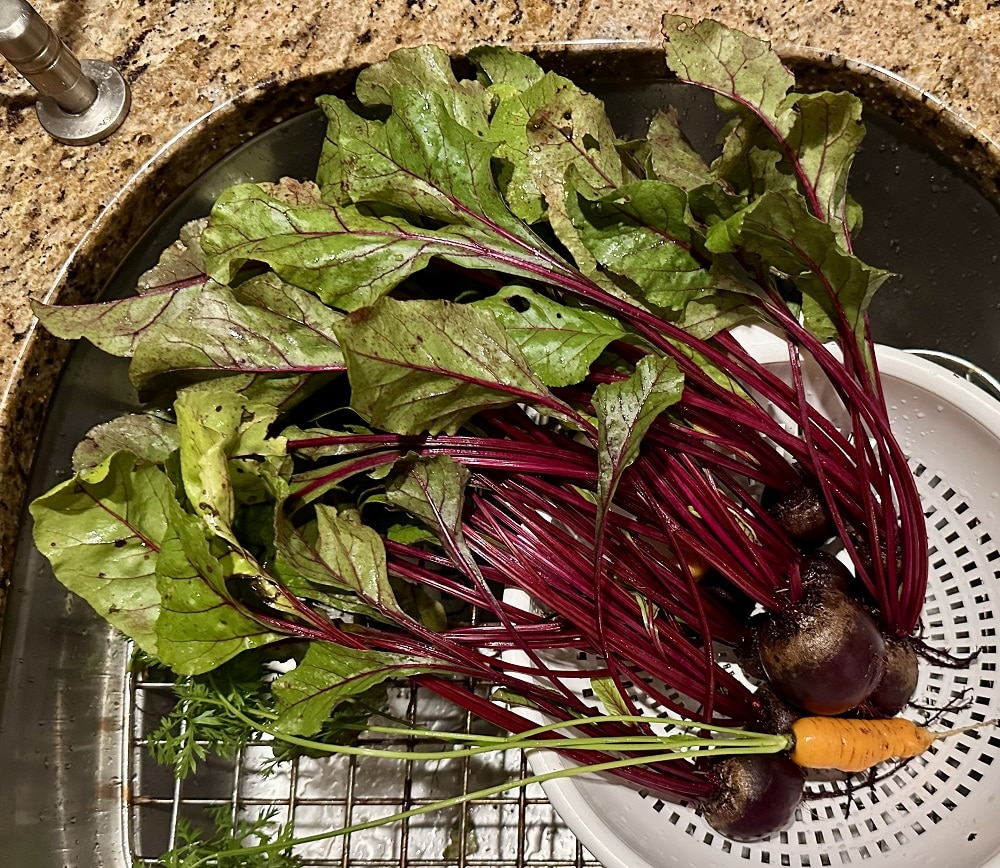
The guys came out while the smaller beets stayed behind to grow. And one little carrot proved that even a crowded garden can give us something good.

A newfound favorite—Red Baron beet greens, insect holes and all. As Mom used to say, “If they’re good for the critters, they’re good for us.”
So, I harvested the big guys over 2 inches wide, letting the smaller ones keep growing. The spring dryness may have stunted them, so perhaps recent rains will help them size up before becoming woody.
Meanwhile, the greens from the big boys were yummy; the insect holes didn’t bother me. “If they’re good for the critters, they’re good for us,” Mom used to say when we took home castaways from the produce stand where we worked. I snagged a few greens from the smaller beets, too, leaving enough for the roots to keep growing.
Beets tolerate frost, their roots protected by the soil. Before a hard freeze, I’ll harvest the rest or mulch them with leaf mold to extend the season.
And why not sow a few more beet seeds for tender baby beets and greens as temperatures cool? It doesn’t matter if the roots stay tiny. The greens are good!
Radishes and crowded carrots get another chance
While inventorying my other seed packets, I came across Cherry Belle radishes from 2022. I had planted two rows from that old packet in spring, as I’ve mentioned in previous posts. There was nothing to lose, and for the first time, the seeds produced plentifully. In previous years, those very same seeds had pitiful outcomes.
It just goes to show that everything in life is a variable. Everything is about change, and unexpected outcomes can bring the greatest delights.
Cherry Belle radishes take only 22 days to harvest, according to the seed packet. Plenty of time remains to grow them again. And the cooler temperatures of fall should help the next crop stay tender. Certainly worth a try.
Then there are my carrots. You may recall our conversation about tiny seeds and how hard they can be to plant. One trick is using the tip of a damp toothpick to pick up each tiny seed and carefully place it where you want it to grow.
Apparently, I could have used that advice when I planted my carrots in April.
Mine came up too close together, and I never thinned them properly. Still, some carrots grew despite being crowded—another reminder that gardens don’t have to be perfect to give us something good.
We can grow despite being crowded, too.
Bigger isn’t always better
Then there was my zucchini.
I watched with anticipation as one zucchini—only one—from three mounds of plants reached a nice size for harvesting. But I decided to let it grow a bit more. The bigger, the better, right? It would be perfect on the grill.
After reaching about eight inches long and plump with promise, the day came to pick my prize, only to find half of it mushy. “Mush-shayd,” I like to say.
The moral of the story: bigger isn’t always better. Last year’s zucchini crop was magnificent. This year, no go. Which makes last year’s bounty even more memorable—and next season, I’ll try again.
Sweet peas aren’t peas for supper

Now that’s a Sweet Pea! Grant, son of my associate gardener Rachel, dressed for the part many growing seasons ago.
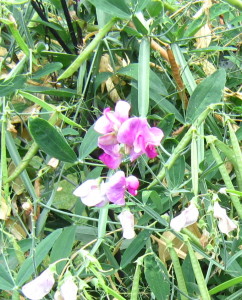
Pretty but not peas for supper. Perennial sweet pea (Lathyrus latifolius) may resemble our edible garden peas, but it is mildly toxic.
By mid-August, it would be easy to call it the end of planting season. Then I came across my leftover snow peas and wondered if it was too late for a fall crop.
A little research brought a clarification that made me smile: Did I mean edible garden peas or sweet peas (Lathyrus odoratus), those wonderfully fragrant annual flowers?
The question took me back to a story I wrote eleven years ago, almost to the day. A client, Melanie of Newton, asked whether the perennial sweet peas covering her pool fence were edible. They sure looked it—dead ringers for peas in our veggie gardens. But sweet peas are mildly toxic, so I’d stay clear.
Lathyrus latifolius, called Perennial Sweet Pea, Everlasting Pea, or Pea-vine, is native to Europe and escaped from gardens. You see it blooming along roads all summer. Unlike its annual relative, it has no scent. The annual sweet pea enchants us with delicate fragrance and beautiful bouquets.
But neither are the peas we should be having for supper.
It’s funny how “Sweet Pea” became a term of endearment. You may recall Sweet Pea is the baby found on Popeye’s doorstep whom Popeye adopts and calls “boy-kid.”
Hey Sweet Pea, why not plant edible peas you can safely eat?
And so here we are, eleven years later, and I’m taking my own advice.
Giving peas another chance

Last year’s Snow peas were bountiful. This year, after a disappointing spring crop, I’m giving them another chance this fall.
Although not everyone may like peas, they are packed with nutrients. They flower, are yummy, and quite cute.
Fall pea crops can be finicky, but the minimal effort and expense are worth a try—especially since my spring crop was such a disappointment. There’s something satisfying about giving peas another chance. Spring didn’t work out, but perhaps fall will.
The trick is harvesting before a hard frost. Peas tolerate light frost, though, and the good old sheet-covering technique can buy more growing time. “Garden ghosts,” I like to call them. On and off the sheets go until November slides in, and we finally realize it’s time to say goodbye to our annual garden guests.
My leftover seeds are Oregon Sugar Pod II snow peas (Pisum sativum ‘Oregon Sugar Pod II’). The packet says 68 days to harvest and shows August to September for fall sowing in our region. Sowing on August 16 puts the theoretical harvest around October 23. Shortening days and cooler fall temperatures can slow maturity. But we eat snow pea pods when they are young and flat, so picking before full maturity is fine. And peas bring protein, fiber, micronutrients, and antioxidants to the table.
Popeye would be proud.
The garden wasn’t vacant after all
Of course, before planting them, I had to reclaim that neglected patch from the stilt grass. And here comes the punchline.
After clearing the stilt grass from a portion of the vegetable garden I had considered vacant, I realized it wasn’t vacant at all. As I pulled out the invader, I uncovered two unusual vegetable plants gifted to me by Steve Oken of Stone Hedge Growers, the nearby farmer who grows annuals for the trade whom we met in Leave Room for Wandering—Unexpected Greenhouse Treasures.
Beneath the stilt grass, the bitter melon grew, its deeply cut foliage twisting delicately around tendrils. And the Italian heirloom squash, also known as snake gourd, was growing with enthusiasm. True, neither plant was thriving. Both had been overshadowed by the invasive grass. But they were still there.
Rather than beat myself up for allowing the garden to become overgrown, I felt gratitude for the gift of their resilience—and mine. Perhaps that is the real lesson.
Our seasons don’t always unfold as we hoped. Maybe the seeds barely produced the first time around. Maybe the carrots grew too close together, the zucchini turned to mush, or the peas never amounted to much. And maybe there are neglected places that wait for us until we’re ready to begin again.
Abandoned plans or lost relationships can open another planting window. What didn’t work in April can be tried again in the August of our lives. The place we’ve neglected—the place we have to weed before we can begin—may be precisely where the next possibility is waiting.
We tend what we can, accept what we couldn’t, and discover it’s not too late to plant again.
Garden Dilemmas? AskMaryStone@gmail.com or tune in on your favorite Podcast App.
 Prefer to Listen?
This story is also a feature in this week’s episode of Garden Dilemmas, Delights & Discoveries, with additional reflections from the screen porch:
Related Posts & Episodes you will enjoy:
Tending What We Can in the Garden of Life – Blog Post
Ep 265 – Tending What We Can in the Garden of Life
Leave Room for Wandering: Unexpected Greenhouse Treasures – Blog Post
Ep 254 – Leave Room for Wandering: Unexpected Greenhouse Treasures
An Honorable Harvest – Blog Post
Ep 183 Honorable Harvest – Downsize Do-over
Hello Sweet Pea – Blog Post


