


Hello, fellow lovers of all things green. As spring unfolds, I find myself reflecting on what remains, what falls away, and what—over time—returns to nourish us again.
After our recent chat on Early Spring Tending, where I shared how I’ve been “reconvening” with the leaves I didn’t tend to in the fall—for good reason—I’ve found myself lingering a bit longer in that work. Sometimes what we leave behind has something to teach us when we return.
And this season, those lessons have reached beyond the garden.
A Walk in the Woods—and an Unexpected Reminder
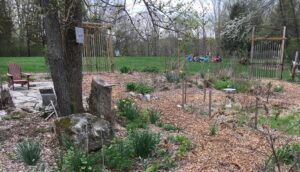
Leaf mold and mulch both have their place—understanding when to use each makes all the difference. (Johnsonburg Retreat Center, NJ, Butterfly Garden)
On Sunday, I was out tending those lingering leaves when Jolee and Boohickles joined me in the woods. It’s always a joy to watch the two of them play—their carefree romping a reminder of how simple life can be when we let it. But then… Boohickles found something—the remains of a mink.
It was a fresh kill, and I’ll admit, the shenanigans between the two of them made me a little queasy. Boohickles—who, I should mention, is Jolee’s boyfriend from up the hill —was quite taken with his discovery. Rolling in it… eating it… fully immersed in the moment, as only a dog can be.
Jolee stayed close to me until he vacated the spot. Then curiosity got the better of her. She went to inspect and snagged what was left—the brown tail dangling from her mouth.

Jolee and Boohickles are enjoying the leaves—before the woods reveal a more sobering side of nature.
She tried to swallow it until she couldn’t quite manage it. Thankfully, Momma’s “drop it” command took hold. Let’s just say the remains had a sea burial in the brook, and my garden gloves are now in the laundry.
Minks Live in Most States
Many people don’t realize that minks live here in Northern New Jersey and most states, except the arid Southwest. We don’t often see them, being mostly nocturnal—quiet, elusive neighbors. I remember last summer, walking Jolee over the bridge that crosses the pond. I saw a dark, sleek figure before she did—a mink. Thankfully, she was on a leash, or it likely wouldn’t have ended well.

An elusive neighbor—rarely seen, yet part of the rhythm of the woods. Photo by: Blaine Rothauser.
To think Boohickles’ find might have been the same little fella, it gives me pause. And I wonder—what would have hunted it and left part behind?
Nature isn’t always tidy. It isn’t always gentle. But it is always part of a greater rhythm—one that asks us to observe, to bear witness, and to remember: Even here, nothing is wasted.
What About Fresh Wood Chips in the Garden?
This leads to a thoughtful question from a client who is having an oak and a maple tree removed. Karen wondered whether the chipped wood could be used as mulch. The answer is yes—with a bit of patience.

Fresh wood chips can be useful—but timing matters.
Fresh wood chips can contain compounds that inhibit plant growth, a natural process known as allelopathy, that may not harm established plants. Even so, it’s best to allow the chips to age for several months before using them in garden beds. Though fresh wood chips make wonderful garden paths.
As with so much in gardening, timing is everything.
How Deep Should Leaves Be in Garden Beds?
Another question came from Steven of Hope, NJ: How deep can leaves be in garden beds?
A good rule of thumb is no more than about 2 inches when using whole leaves. Huskier leaves—like oak, tulip tree, or sycamore—should be applied more lightly to prevent matting, which can block water and air from reaching plant roots and soil microbes.
If you shred leaves first—by running them over with a lawn mower—you can apply them up to 4 inches deep. And better yet…You’ll be on your way to something even more valuable — Leaf Mold!
Leaf Mold vs. Mulch: Nature’s Natural Advantage

Leaf mold in the making—nature’s quiet transformation at work.
Leaf mold is simply composted leaves with remarkable benefits. Over time, they break down into a rich, dark, earthy material packed with minerals.
When added to the garden, it improves soil structure, helps retain moisture, feeds earthworms and beneficial microbes, and suppresses weeds.
Unlike traditional wood mulch, leaf mold works with the soil rather than just as a surface layer.
You can make leaf mold by piling leaves and letting them decompose over one to three years. Shredded leaves break down faster—often within six to twelve months. Some gardeners speed the process using perforated bags with added moisture and a bit of soil.
When you apply leaf mold as a mulch, about 2 to 3 inches deep, nutrients seep into the soil, nourishing roots.
The mulch you buy is a broader topic—one that raises questions.
And importantly, not all wood mulch is created equal. Dyed mulches are often made from recycled construction debris, which may contain pressure-treated wood. The dyes themselves are often petroleum-based and can be harmful to plants.
There’s also the issue of heat. Dark mulches absorb and radiate warmth, which can stress plants. I liken it to walking barefoot on a hot driveway in midsummer—not something we’d choose, and not something our plants would appreciate either.
Natural mulches, such as aged hemlock, are a better option. Properly aged mulch has had time to break down, making nutrients more accessible and reducing the risk of drawing nitrogen from the soil.

A layered garden becomes its own mulch—plants weaving together to shade and nourish the soil. (my client Tara’s lovely garden)
When Gardens Become Living Mulch
Keep in mind that we don’t always need to re-mulch gardens every year. As plantings fill in, they begin to function as a “living mulch,” shading the soil and naturally helping retain moisture.

When gardens mature, they begin to care for themselves—nature’s version of living mulch.
I adore layered gardens—a design technique that uses an assortment of plants of varying heights, shapes, and textures that overlap in complementary and contrasting colors. In a few years, they require no mulching at all.
In lawns, too, small adjustments can make a meaningful difference. Keeping grass at a height of three to four inches—closer to four is ideal—supports pollinators, reduces water needs, and encourages stronger root systems. It also allows the tapestry of flowering lovelies—blue violets and clover in my “unconventional” lawn—to shine. Skipping pesticides and embracing practices like No-Mow May offer additional opportunities to support wildlife during a critical time.
Gardening, like nature, is not something we control, but something we participate in. The leaves we rake, the mulch we choose, and the way we tend the soil are all part of a larger cycle—one that reminds us, again and again, that nothing in nature is wasted.
 The Lesson of the Leaf… a personal reflection
And perhaps that’s what I’ve been thinking about most this week. Nothing is wasted.
Not just in nature and the garden, but in life. This season—Easter in particular—has a way of holding both endings and beginnings in the same breath. And I found myself sitting with a heartfelt question. Whether to send a card to someone who has been part of my life for more than two decades. Someone who welcomed me into her family, beginning with an Easter so many years ago, when she invited me to brunch, and her son asked if he could pick me up. That was our first date.
As life unfolded, I became part of their family in a way that felt lasting and deeply meaningful. But as some of you know, that chapter has come to a close. Not in the way I’d hoped. And with that ending came the sorrow of losing not only a relationship but a family I had come to love.
So I sat with the question— Do I reach out? Not to reopen anything. Not to change what is. But to acknowledge what was. To say thank you. To honor the years.To close the circle with gentleness.
Trusting the Movement
And what came to me was something the garden has been teaching all along. The Lesson of the Leaf. Like a leaf in the water—released, not abandoned. The leaf doesn’t decide where the current takes it, but it trusts the movement.
And perhaps that’s what we’re asked to do in moments like these. To offer what we’ve been holding with care and then let it go where it needs to go. Because sometimes the most loving thing we can do is place what we’ve carried gently into the current—and trust it will find its way. Not forcing an outcome. Just allowing.
So I sent the card, like placing a leaf upon the water. With gratitude. With love. With beautiful memories. And without expectation.
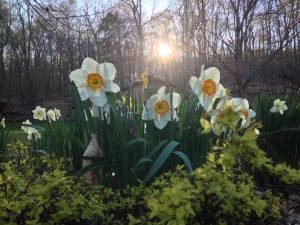
Letting go is not the same as losing.
We don’t lose the love. We don’t lose the years. We release the holding. And in doing so, make space for something new to take root.
In the garden and nature, we see it every day. What falls breaks down and feeds what comes next. Nothing is wasted. Not the leaves. Not the seasons. Not even the chapters that didn’t end as we hoped.
And maybe that’s what this time of year is whispering to us. Gardening, like life, is not something we control—but something we participate in. And if we’re paying attention, it will show us—again and again—how to let go, how to begin again, and how to trust the turning.
Garden Dilemmas? AskMaryStone@gmail.com or tune in on your favorite Podcast App.
Prefer to listen? 
This story is also shared in this week’s podcast episode, with a few additional reflections from the screen porch.
🔗 Links to Related Posts and Podcast:
No-Mow May helps Pollinators – Blog Post
Ep 103 – No Mow May & Marvelous Moss
Leaf Mold – Better than Mulch– Blog Post
Early Spring Tending: What to Keep, What to Clear – Blog Post


