


Hello fellow lovers of all things green,
Mile-a-minute weed and Japanese stilt grass have decided to cohabit in parts of my woodland, creating a knotted-up carpet of mini bamboo-like stilt grass roped around a triangular-leafed invader with one of the most perfectly descriptive common names there is—mile-a-minute weed.
Keeping Mile-a-Minute Weed in Check

Mile-a-minute and Japanese stilt grass have decided to cohabit, creating a knotted-up carpet in parts of my woodland.

Cooking the heck out of mile-a-minute on the driveway so the roots can’t re-root themselves in the brush pile. Jolee supervises.
Its botanical name is Persicaria perfoliata, and it can grow as much as six inches a day and twenty-five feet in a season. It hangs like thick drapery over trees and shrubs, shading the plants beneath it and hindering their photosynthesis.
The almost perfectly triangular leaves make mile-a-minute weed easy to identify. Its flowers are insignificant, but then come green berries that ripen to a reflective blue. Birds and other critters eat the berries and help spread the seeds far and wide. So I’ve been determined to keep mile-a-minute in check. Thankfully, it’s pretty easy to pull, although I wear gloves because it is prickly and sticky.
The other morning, before heading out for a client meeting, I pulled a bunch and piled it in the driveway to cook the heck out of it, so the roots wouldn’t remain viable and re-root themselves in the brush pile.
When Mother Nature Skims the Pond

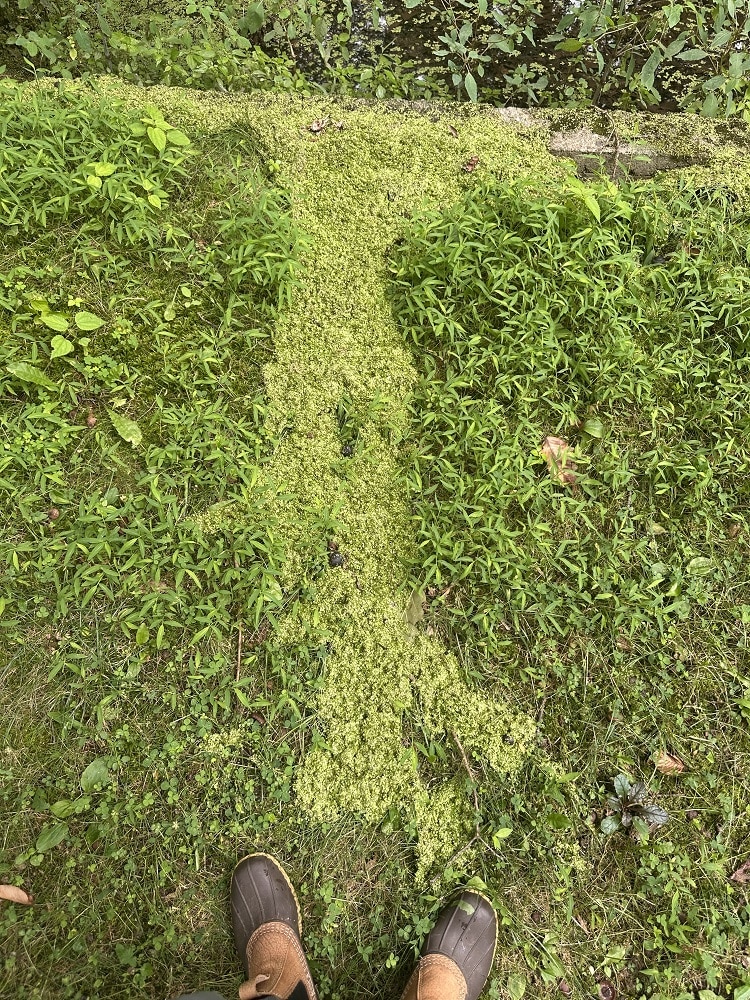
A three-and-a-half-inch storm skimmed much of the duckweed from the pond, leaving this remarkable green trail behind.
Speaking of weeding, a favorable outcome of heavy rains involves my pond. Until recently, it was covered in duckweed—that fascinating plant we spoke about in The Tiny Wonder of Duckweed. It’s amongst the smallest flowering plants in the world, and while it reproduces quickly, it’s beneficial. But I admit I missed seeing some clear water.

The Great Blue Heron enjoys the pond, too—and with clearer water, his prey is easier to see. Sorry, frogs.
During a three-and-a-half-inch storm, the rushing water swept much of the duckweed away, leaving some skimmed along the edges of the pond and in the overflow. Another storm later cleared the rest. Mother Nature did the skimming for me. The frogs are more visible now, and I adore how the trees reflect on the surface like a mirror.
I’ve described before how my pond helps control mountain runoff. There’s a cement dam at the end—gratefully, now largely covered with moss—and an overflow trough that dumps the water toward the Johnsonburg Creek.
The Great Blue Heron seems pleased with the clear water, too. His prey is easier to see. Sorry, frogs.
Isn’t that how nature works? There is almost always another side of the equation.
Japanese Stilt Grass—Also Known as Mary Grass
Back to my other weeding mission: Japanese stilt grass, Microstegium vimineum, has become increasingly prevalent in my woods. Another common name for it, oddly enough, is Mary Grass. I have no idea why—but I take no ownership.
Maybe it’s just me, but the stilt grass seems taller this year—about knee-high in places. It is kind of a pretty, soft grass if you didn’t know how aggressive it is—squelching out desirable native plants.
There’s an old rock wall that’s begun to disintegrate, and I’ve been slowly restoring it myself, repositioning some of the stones. So after tackling the mile-a-minute, I started weeding the stilt grass to reveal the ferns and sedges that have naturalized there.
When pulling stilt grass, I always wear long sleeves and garden gloves. I’ve heard from people who have developed terrible rashes after working around it.
Beauty Amongst the Undesirables
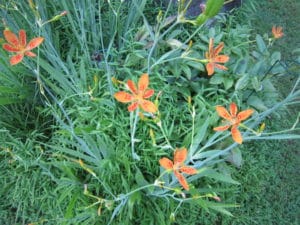
Suzanne’s Blackberry Lilies managed to bloom beautifully amongst the stilt grass—something lovely thriving amongst the undesirables.
Stilt grass reminds me of a garden renovation I worked on several years ago for Suzanne. Her Blackberry Lilies were growing amongst a serious infestation of stilt grass. Of all her perennials, they seemed to be competing heartily with it.
Blackberry Lily, botanically known as Iris domestica, isn’t really a lily at all. Its charming orange flowers are followed by seedpods resembling blackberries, which is where the common name comes from. And yes, it can be an enthusiastic self-seeder.
But what I remember most is the sight of something so lovely managing to grow amongst all those undesirables.
Funny how certain plants—and certain dilemmas—keep showing up in our stories. Maybe that’s because they keep showing up in our lives.
Weeding Out the Undesirables
As I knelt clearing around the old wall, I thought about other parts of the garden I hadn’t gotten to. You know what? We do the best we can. And we start by weeding out the undesirable things that bother us most.
There will always be another weed to pull. Another stone to put back into place. Another part of the garden that needs tending. And another part of our lives that does, too.
Last week we talked about letting go of what we cannot control—allowing ourselves to be like a leaf floating with the current rather than fighting against it.

Mother Nature did the skimming for me, revealing open water and beautiful reflections once again.
Tending What We Can
Maybe this week’s lesson is the companion to that. While we let go of what we cannot control, we can tend what we can. We don’t have to clear the whole woods, put every stone back in place, or weed the whole garden. Clearing a little space around an old stone wall so the ferns can show themselves again is enough.
Indeed, there will always be undesirables amongst the beautiful things in our gardens and in this garden of life. But there will also be Blackberry Lilies blooming amongst the stilt grass, ferns waiting beneath the weeds, frogs suddenly visible in clear water, and another chorus waiting to begin as one chorus ends.
We aren’t meant to tend everything at once. We tend what we can, when we can, and trust that the rest will wait until we get there.
Garden Dilemmas? AskMaryStone@gmail.com or tune in on your favorite Podcast App.
 Prefer to Listen?
This story is also a feature in this week’s episode of Garden Dilemmas, Delights & Discoveries, with additional reflections from the screen porch:
🌿 Related Podcasts and Posts You’ll Enjoy:
Another Lesson from the Leaf: Help Is on the Way – Last week’s post
Blackberry Lily & Soil Remediation – Blog Post
Mile-a-Minute Weed Remedies – Blog Post
Episode 107 — Mile-a-Minute Weed and Butterfly Magnets


