


Hello, fellow lovers of all things green,
Susan from Blairstown, NJ, wrote to me and shared what many of us are feeling:
“Spring can’t come soon enough. I miss the flowers and plants of summer. A friend reminded me that this hard winter is long overdue, though — that it curbs the bad bugs. I hope ticks are on that list!”
Don’t we all hope so.
But ticks, like many insects, are remarkably resilient. Even when temperatures drop into the single digits, they don’t simply disappear. They tuck themselves beneath leaf litter and snow cover. And snow acts like a thermal blanket. Under a foot of snow, soil temperatures often hover close to thirty-two degrees, even while the air above is bitterly cold.
When temperatures drop below freezing, ticks and other insects enter a dormant state called diapause—slowing down and conserving energy while waiting for warmer temperatures to return.
And when we get milder winter days above thirty-five or forty degrees, they can become active again. So, tick checks remain important year-round.
A Bigger Conversation
Susan’s question leads to a bigger conversation — one I found myself immersed in yesterday at the New Jersey Nursery and Landscape Association’s Total Pro Expo, postponed from January’s blizzard.
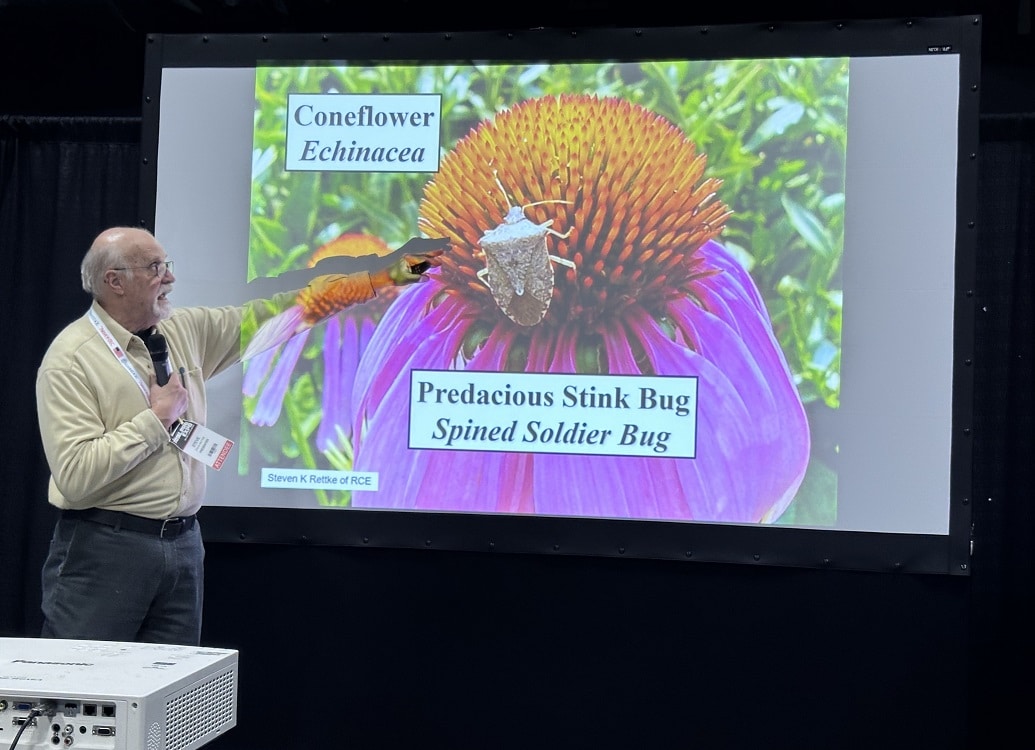
One presentation especially stayed with me, given by Steven Rettke of Rutgers Cooperative Extension. His talk was titled: “Backyard Beneficials: Inviting Insects into the Landscape.” But not ticks, thank you very much.
It’s astounding to learn that while about two percent of insects in North America are exotic, meaning they come from other countries, nearly half of our major pest insects are exotic.
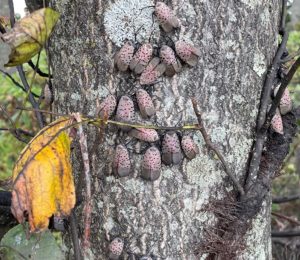
Spotted Lanternflies on Tree of Heaven
We are aware of the recent dilemma posed by the Spotted Lanternfly, which lays its eggs on the non-native invasive Tree of Heaven (Ailanthus altissima). Their activity is killing their host trees. Once depleted, which will likely take many more years, I wonder what they’ll jump to next as a favorite host. I’ve already seen them jump to maple trees.
Then there’s the Emerald Ash Borer; not many ash trees remain here in New Jersey. I’ve heard the emerald ash borer has jumped to the white fringetree (Chionanthus virginicus), with fragrant, fringe-like white flowers in late Spring and dark blue fruit in late summer to early fall that attracts birds.
So exotic insects adapt and modify to their new environment.
But most insects belong here. They are part of a balanced, living web.
Biological Control Is About Balance

Steven Rettke of Rutgers Cooperative Extension
Biological control is not about eradicating pests. It’s about balance, something I hope continues to change in the mindset of many as we embrace more native plants and the natural way of balancing things. By allowing predators, parasitoids, and pathogens to reduce pests below damaging levels — not to eliminate them. Because eradication is neither achievable nor desirable.
Those “bad bugs” we sometimes wish winter would wipe away? They are also food. And predators need prey.
Lady beetles, Lacewings, Hoverflies, Assassin bugs, Minute pirate bugs, Predatory mites, to name a few, occur naturally. They often prevent pest outbreaks. And perhaps best of all, they work for free.
Unless, of course, we unintentionally kill them with broad-spectrum pesticides. It’s such a clear cause-and-effect. We want fewer pests, and some people spray, killing the very allies doing the work for us.
Designing for Balance
We can design landscapes that invite beneficial insects by Increasing Plant and Habitat Diversity, providing Nectar and Pollen, and Increasing Habitat Stability.
- Simple landscapes (low in plant diversity, with lots of space between plants) tend to be hot, dry, and sunny and are more prone to pest outbreaks.
- Complex landscapes, on the other hand, are rich in plant diversity, layered with native plants, wall-to-wall in color and texture (as I like to design), and cooler, moister, and shadier.
The dense plantings, layered vegetation, and diverse flowering plants create shelter, food, and stability.


Steve shared encouraging research that after 10 to 15 years, diverse urban landscapes often stop experiencing major pest outbreaks. In fact, over ninety percent of plants in mature landscapes are essentially pest-free. Not because homeowners fought using nasty chemicals. But because balance had time to grow.
Flowers as Invitations
Another beautiful reminder from Steve’s slides:
“Flowers are not just decoration. They are invitations.”
Steve, a self-professed non-plant expert, provided a list of flowering herbs and wildflowers that produce abundant nectar & pollen. Some of which are native plants such as:

Goldenrod
Showy Goldenrod (Solidago speciosa)
Wrinkleleaf Goldenrod (Solidago rugosa)
Sunflowers
Giant Sunflower (Helianthus giganteus)
Woodland Sunflower (Helianthus divaricatus)
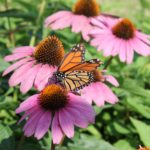
Purple Coneflower (Echinacea purpurea)
Coneflowers
Purple Coneflower (Echinacea purpurea)
Yellow Prairie Coneflower (Ratibida columnifera)
Cutleaf Coneflower (Rudbeckia laciniata)
Blazing Star
Dense Blazing Star (Liatris spicata)
Slender Blazing Star (Liatris cylindracea)
Angelica
Purplestem Angelica (Angelica atropurpurea). I adore the stunning purple stems and large, umbrella-like flowers atop two-foot-wide leaves.
My Additional Adored Native Favorites
Each one offering nectar… pollen… shelter… life.

Wasps are pollinators too, enjoying Short-toothed Mountain Mint
Mountain Mint / Pycnanthemum muticum and Pycnanthemum virginianum
Wild Bergamot / Monarda fistulosa
Anise Hyssop / Agastache foeniculum
Northern Bayberry / Morella pensylvanica
Wild Ginger / Asarum canadense
American Wild Carrot / Daucus pusillus
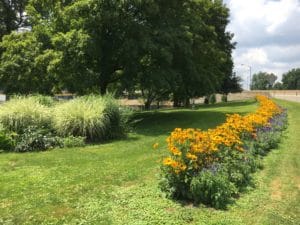
Black-Eyed Susan are host and nectar plant. The photo was taken in Point State Park, an urban garden in Pittsburgh, PA.
Yarrow / Achillea millefolium
Black-Eyed Susan / Rudbeckia hirta
Mistflower / Conoclinium coelestinum
Wild Blue Phlox /Phlox divaricata
Wood Sorrel / Oxalis stricta
A Word on Biorational Pesticides

Steven Rettke’s List of Biorational Pesticides
Steve wrapped up his chat with a list of Biorational Pesticides derived from natural sources such as plants, microorganisms, or minerals. They break down quickly and target specific pests, suppressing them rather than eradicating them, with far less impact on non-targeted organisms. Among them is my go-to Neem Oil.
Steve also shared some heavier hitters that are safer than chemical pesticides (see slide).
Even when pest control becomes necessary, the message remains the same: Choose targeted, biorational approaches that protect beneficial life whenever possible — horticultural oils, insecticidal soaps, biological products, and carefully selected treatments compatible with pollinators.
Because the goal is not to eradicate it, but to encourage harmony.
The Garden of Life
Driving home from the landscape show, I passed winter-farm fields resting beneath snow and thought about how this conversation mirrors our lives. We try to eliminate every discomfort, frustration, or unwelcome presence. But nature shows us something wiser.
Balance doesn’t come from removal. It comes from relationships, from diversity, and the patience of allowing time — sometimes ten or fifteen years — for harmony to take root. So, it’s not about getting rid of bad things. It’s how to propagate more of the good things.
Kindness. Beauty. More life. More love.
Garden Dilemmas? AskMaryStone@gmail.com or tune in on your favorite Podcast App.
If this conversation resonates with you, there’s more to explore.
Join me for this week’s episode, where we explore how balance grows when we invite more of what sustains life.
Related Podcasts and Posts you’ll Enjoy:


