


Hello, fellow lovers of all things green,
After the story about the wisdom of Harvesting Rainwater & Snowmelt, I heard from Jennifer in Bangor, Pennsylvania. Her fiddlehead fig tree had developed yellowing leaves. How delightful it is when one question leads back to a familiar story — and how often our plant dilemmas echo lessons we’ve already lived. That recognition landed close to home, arriving during a season when I, too, was learning the difference between tending and over-tending.
Fiddle-Leaf Fig trees (Ficus lyrata), also known as Fiddlehead Figs, grow in rainforests and are native to West Africa, where they can reach forty feet. As houseplants, they stay shorter, of course, and rarely flower or fruit, but they still command attention. Their foot-long, leathery leaves with wavy edges and pronounced veins resemble a fiddle — hence the name—no wonder they’ve become a household favorite.
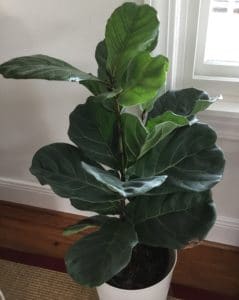
Their leathery silhouette looks like a fiddle.
Yellowing leaves are often a sign of too much water.
Jennifer’s dilemma took me back to a client in Sparta, New Jersey, who once wrote, “Remember that fiddle-leaf fig tree I loved? The leaves are turning yellow. I googled it. It said fertilizer might help. I ordered a bigger pot and fresh soil. It gets great light and hasn’t moved in two years. Any thoughts?”

Suze’s fiddlehead fig with yellowing leaves.
Typically, I advise against fertilizing houseplants in winter, when they’re resting. But if a plant hasn’t been fed during the growing season, a gentle boost may help, but watering habits are usually the bigger issue. Yellowing leaves, by and large, are a sign of too much water. I suggested a simple moisture meter probe—an inexpensive tool that removes the guesswork from soil moisture monitoring.
Self-watering pots pros and cons.
Suze later explained that her fig was in a self-watering container — the kind that holds a reservoir of water beneath the soil. These systems are helpful in summer or while away from home. They maintain consistent moisture without daily attention. But in winter, when plants slow their growth, constantly moist soil can become a problem. Many houseplants prefer their soil to dry slightly between waterings.
Fiddle-Leaf Fig trees are Fickle.
Fiddle-Leaf Figs are known for being a bit fickle. They dislike drafts, soil that stays too wet, sudden temperature changes, or dry indoor air. A nearby humidifier can make a surprising difference.
When I later visited Suze to review a garden design, her fiddlehead fig stood tall in its new pot. Repotting in winter isn’t usually recommended, as plants are resting, but in this case, the roots were crowded and the soil sparse. Sometimes exceptions are necessary — in gardening and in life. That reminder felt especially true at the time, as I was navigating my own period of transition—learning when to pause and trust that roots would find their way.
During that visit, Suze pointed to another houseplant — a split-leaf philodendron — with fuzzy white patches on its leaves. “I’ve been wiping it off,” she said, “but it keeps coming back.”
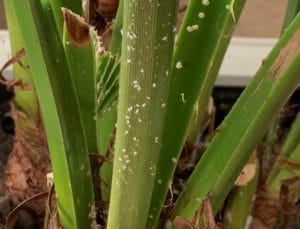 Mealybugs and whiteflies look similar.
Those cottony clusters looked like mealybugs, though at first glance they can resemble whiteflies. Both are sap-sucking pests that cause leaves to curl and yellow. Both are masters of stealth, hitching rides indoors on fresh-cut flowers, produce, or plants kept outside in summer. Sometimes they come home with a new plant.
Safe Remedy of Good Riddance
The remedy for both dilemmas is straightforward, though it takes patience. Isolate the affected plant. Rinse it gently in a sink or shower if possible. Let the plant dry, then spray Neem Oil periodically until all signs of the invasion are gone. The whiteflies will fly when you spray them, but the treatment will kill eggs and nymphs. Be sure to spray the undersides of leaves where they lay their eggs — sneaky little buggers.
If the darn things keep coming back, remove the top two inches of soil where they could be living. Clean the inside of the pot with rubbing alcohol, then top-dress with fresh potting soil. Patience and attentiveness are part of tending to plants.
Perhaps there’s a deeper lesson here. As I share more fully in the podcast episode, this plant story unfolded alongside a personal one—both asking for patience and compassion. Plants remind us that care is an ongoing relationship. Too much or too little water, too much or too little attention — balance matters. In our homes, our gardens, and within ourselves, growth thrives when we listen closely to what’s needed and respond with steady, loving care.
Garden Dilemmas? AskMaryStone@gmail.com or listen on your favorite Podcast App.
There’s more to this story in the Garden Dilemmas podcast, where the plant lesson unfolded alongside a personal season of change—and how listening closely made all the difference.
Link to a Related Podcast and Blog Post:
Ep 237. Roofs to Roots: Reviving Houseplants
Harvesting Rainwater & Snowmelt Wisdom – Blog Post


