


Hello fellow lovers of all things green,
As you may recall from a spring chat, I am now in charge of maintaining the lawn and think back on the nervousness I felt, having never operated a beefy riding mower. Years ago, I opted to push-mow the steep slope covering most of the front lawn leading toward Jacksonburg Creek.
The good news is my early apprenticeship with the John Deere unfolded gratefully slowly, as our unusually dry spring kept the lawn from growing much. Alongside that benefit, however, the clover and grass seed I spread to repair areas disturbed by last fall’s boulder wall construction didn’t grow very well. So, a second round of seeding this fall is in store.

Autumn arrived ahead of schedule beneath my beloved sugar maple this year.
When autumn arrives early
Almost three weeks before the official start of fall, while mowing the lawn, I noticed many leaves had already fallen from my adored sugar maple near the screened porch, gracing the back lawn toward the footbridge.
Oddly, most hadn’t displayed their usual autumn brilliance. Some were yellow, but most browned and dropped.
I adore how the maple’s bark is alive with a tapestry of powdery blue lichen interwoven with moss. Rest assured, their presence does not indicate the tree’s demise.
Let lichen and moss be

An old-world tapestry on my sugar maple—beautiful, fascinating, and innocent of the early leaf drop.
Unlike opportunistic plants such as wisteria, poison ivy, mile-a-minute weed, and kudzu that can smother trees, moss and lichen cause no harm. They’re merely seeking a structure to call home—trunks, branches, rocks, even furniture.
Lichen is especially fascinating—a partnership primarily between fungus and algae or cyanobacteria. The photosynthetic partner makes food, supporting the fungus and creating a remarkably self-sufficient combination that takes no nutrients from the tree. Think of lichen as an air plant of sorts (Tillandsia spp.), those trendy alien-looking houseplants that don’t require soil.
Lichens can also reveal air quality; pollution-sensitive species decline when air quality deteriorates. My maple’s lichen seems to be breathing well and happily thriving.
Fallen leaves become garden gold
Back to the plentiful early fallen leaves. Initially, I mowed over them a few times, mulching them into the lawn where they’ll decompose and return nutrients to the soil. Two weeks later, the leaf drop was far too much to mow.
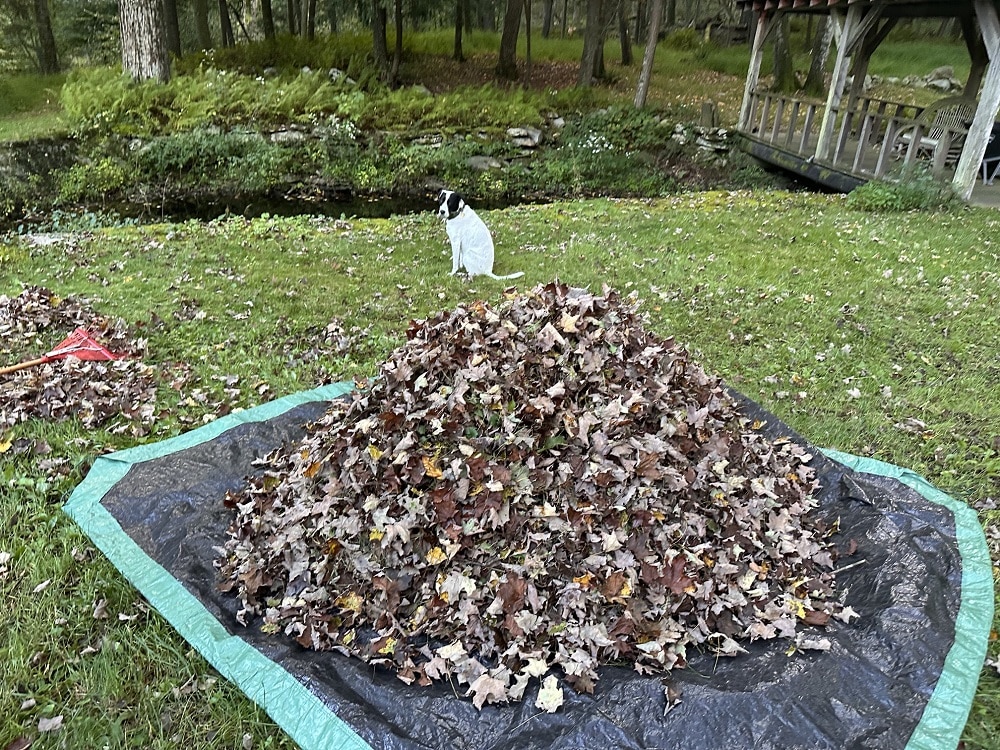
So, the day before the official start of fall, Jolee and I raked leaves onto a tarp and dragged them to the compost pile to create leaf mold.
Decomposed leaves feed earthworms and beneficial microbes, help lighten clay soil, retain moisture, and suppress weeds—a far more beneficial mulch, in my book.

Jolee supervises as an unexpectedly early crop of leaves heads toward the compost pile.
While raking, I was shocked by the pile’s size. I looked up and realized nearly half the maple’s canopy was already bare.
Why is my sugar maple dropping leaves early?
Premature leaf drop without the usual fall color can signal stress, and I suspect our roller coaster of weather contributed—an unusually dry spring followed by a remarkably wet summer.
Sugar maples (Acer saccharum) are sensitive to drought. When water becomes scarce, trees can slow photosynthesis and ultimately shed leaves to reduce water loss.
Indeed, letting go can be a means of survival.
Sound familiar?
A little tree begins again

Just when I was ready to give up, a tiny sign said otherwise.
Speaking of resilience, last November, when the new boulder wall was built, I transplanted a five-foot-tall, skinny-trunked volunteer tuliptree (Liriodendron tulipifera) that was in the way. All season I watched for signs of life. No leaves formed, though the wood remained flexible.
I held hope—until recently, when the upper branches became brittle. With a volunteer sycamore gifted by a dear friend in hand, I decided to replace the baby tuliptree. As I weeded around its base, preparing to dig it up, I discovered adorable tiny green leaves.
The little tree wasn’t dead after all. It was regrouping. While everything aboveground appeared lifeless, the roots had been busy preparing to push out new growth.
The resilience of trees. One letting go of leaves early, conserving resources after a stressful season. Another preparing to begin again. And the lichen thriving, asking only for a place to call home.
What looks like decline isn’t always demise. Letting go can be part of surviving. And sometimes, when nothing seems to be happening, growth is underway beneath the surface.
The same is true in our own Garden of Life.
Garden Dilemmas? AskMaryStone@gmail.com or tune in on your favorite Podcast App.
Related Posts and Podcasts you’ll enjoy:
Also featured in Episode 61 – A Story of Treasured Tuliptrees
Also featured in Episode 49 – A Soft Spot for Lichen & Moss
Also featured in Episode 05 – NY Botanical Garden, Fall Leaf Confetti


