


Finding What Belongs
Hello, fellow lovers of all things green,
It’s always such a joy to hear from clients—those from long ago and those I visit each year for garden tune-ups. Recently, I heard from Pam in Sparta, New Jersey, whose garden I designed ten years ago. Together with my associate installer, we transformed a very steep backyard into something special—garden steps among tiered boulder walls, and a quaint stone patio overlooking what became a meadow of sorts, a lawn mixed with wildflowers, where their dogs can run freely within a deer fence. And in Sparta, that’s no small thing—the deer pressure there is among the worst.

Landscape design plan by Mary Stone of a sloped backyard in Sparta, NJ.

From concept to completion—transforming a steep Sparta, NJ backyard into a series of garden rooms with stone steps, a patio, and layered plantings.
When Familiar Plants Begin to Fade
Pam shared that her rhododendron has been declining over the past few years. Nursery professionals attributed it to drought and advised more watering, but unfortunately, that hasn’t helped. Her pachysandra, once lush and established before I ever arrived, has nearly disappeared.
I’m hearing more and more about rhododendrons struggling in our region. Extended periods of drought, followed by intense rain events, can stress their shallow root systems. Add to that erratic temperature swings, and it’s no wonder we’re seeing an increase in root rot, lace bug damage, and general decline.
A Better-Fitted Alternative
As for pachysandra, what Pam is experiencing is widespread here. Pachysandra terminalis, the familiar Japanese pachysandra, has been hit hard by Volutella blight, a fungal disease. It causes yellowing, thinning, and dieback, especially in stressed or overcrowded plantings. What once seemed like an indestructible groundcover is, in many gardens, fading away.
Instead of replacing it, I favor our native Allegheny spurge (Pachysandra procumbens). It has a softer, more natural habit, forming lovely colonies of blue-green foliage with hints of silver and purple that deer don’t favor. Unlike its non-native cousin, it is not overly aggressive, squelching out other plants, and supports wildlife, including early pollinators.
The good news is that much of Pam’s garden is still thriving, including oakleaf hydrangea along the back deck (Hydrangea quercifolia), “A Plant for All Seasons,” I rave about. And her pink flowering tree peonies (Paeonia suffruticosa) are standing tall and elegant. These grafted woody shrubs have the strength to hold their magnificent blooms upright, unlike their herbaceous counterparts, which tend to flop.

Tree peonies standing tall in the front garden—their structure and strength a beautiful contrast to their delicate blooms
I’m looking forward to meeting with Pam and Ed for a Landscape Review & Recommendation consultation—to assess the declining plants and explore thoughtful replacements and adjustments.
As we reminisced about our first time working together, I asked whether they still had dogs. “Yes,” Pam said, naming the same two—now 11 and 12. It’s funny how we mark the passage of time—through our children, or for many of us, our beloved canine companions. I had Miss Ellie then. Now, it’s Jolee.
Ants, Moss, and a Shift in Perspective
Pam and Ed are also the same clients who once had an ant dilemma in their bluestone patio. What a treasure to revisit that story from 2017. Their shady patio has welcomed a soft carpet of moss between the stones that they adore. The dilemma? Ants have taken up residence.
“What do you recommend for keeping ants out and the moss in?” they asked.
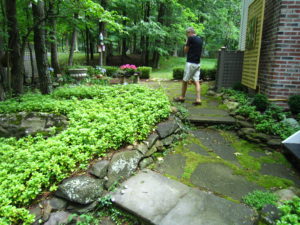
Pam and Ed’s lovely stone patio.
When I first wrote about that situation years ago—my Ants Be Gone piece—I’ll admit, I was focused on solving the problem. But over time, and especially after our conversation in Admiration for Ants & Safe Remedies, I’ve developed a new appreciation for ants.
It doesn’t mean we want them in our patios—but it does change how we approach things.
Back then, I shared several remedies—some more effective than others. Vinegar sprays can work, but they’re highly acidic and can damage surrounding plants… including that moss you’re trying to preserve. Borax-based baits are more targeted, carried back to the colony to address the source—but I’d rather move ants along.
Natural deterrents like cinnamon, cayenne, or garlic don’t eliminate ants so much as redirect them. And that brings us back to perspective. Sometimes the goal isn’t total elimination. Sometimes it’s about balance.
Because ants, like so many creatures in the garden, are part of a larger system. They aerate the soil. They help break down organic matter. They’re not villains—they’re simply in the wrong place for our liking.
Moss Is the Messenger
And now, a new twist—Pam is wondering about the front lawn, where grass struggles and moss thrives.
But moss isn’t the problem. It’s the messenger.
Moss lives where conditions favor it—shady areas with 4–6 hours of sunlight or less, compacted or poorly drained soil, low fertility, and often acidic conditions (typically a pH around 5.0–5.5). In these environments, grass struggles, and moss steps in to do what it does best.
Lawn enthusiasts try to “fix” moss by removing it, liming the soil, or forcing turf to grow where it simply doesn’t want to. But instead of fighting the moss, let’s embrace it as a moss lawn alternative—or consider planting groundcovers that naturally thrive in the same conditions.
A few beautiful, deer-resistant native options include:
- Golden ragwort (Packera aurea) – cheerful yellow blooms in spring
- Foamflower (Tiarella cordifolia) – delicate flowers and soft woodland texture
- Wild ginger (Asarum canadense) – lush, low-growing foliage for deeper shade
Combined, they create a beautiful tapestry—one that supports pollinators and enriches the soil.
A Garden (and Life) Lesson
And moss… well, moss invites a different kind of reflection.
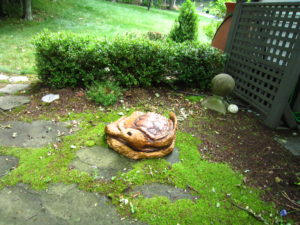
Learn to embrace moss within patios and as a lawn alternative.
I always find it interesting how we cherish moss in one setting—tucked between bluestone, lining a woodland path—and yet in a lawn, we label it a problem.
Same plant. Different story.
What if, instead of trying to fix moss, we saw it as a guide? An invitation to reconsider how we use that space. To work with it instead of against it.
And on a warm day, I invite you to try something simple—take off your shoes and socks and stand on a patch of moss. Feel its softness. Its texture. It’s called grounding—or earthing—and there’s something deeply settling about it.
The garden and nature aren’t just something we look at. It’s something we experience.
And maybe that’s the deeper takeaway from Pam’s story.
Whether it’s a struggling plant, a patch of moss, or even a trail of ants—the garden is always communicating.
And when we listen—really listen—we begin to understand not just what will grow best there…
…but how we might grow, too.
Garden Dilemmas? AskMaryStone@gmail.com or tune in on your favorite Podcast App.
Prefer to listen? 
This story is also shared in this week’s episode of Garden Dilemmas, Delights & Discoveries, with a few additional reflections from the screen porch:
Related Posts and Podcasts:
Blog Posts:
- Ants Be Gone
- Admiration for Ants & Safe Remedies
- Magnificent Moss
- Native Rhododendrons
- Oakleaf Hydrangea for All Seasons
Podcast Episodes:
- Ep 121 – Admiration for Ants & Safe Remedies
- Ep 249 – Living Mulch: Layering with Native Plants
- Ep 173 – Oakleaf Hydrangea for All Seasons
- Ep 10 – Beauty in Dreariness, Furry Invaders
- Ep 250 – Weeping Cherry Dilemmas: Trees Tell a Story


