


Hello, fellow lovers of all things green. We are past the peak of fall colors, though there’s still more to enjoy. Before me are the brilliant red leaves of a Japanese Maple and the golden glory of Bottlebrush Buckeye, dancing on in the breeze, bringing to mind how leaves change color and how the sequence of fall leaves brings new life.

Jolee and Boohickles are best friends.
Boohickles and Jolee
Yesterday I tended to some Shagbark Hickory nut and leaf cleanup. Jolee put on quite a show amongst the leaves and noshed on a few nuts. Then her boyfriend Boohickles showed up. My neighbor Bill was on his quad with his younger daughter, then Boo joined the ride. Jolee was thrilled! I adore watching them wrestle and chase. As they frolicked, Bill commented on my maple trees. They are in their dark red stage before they shift to their bright red blaze.


We’ve had a lackluster fall here in Northern New Jersey, but the grand finale of red leaves did not disappoint. The ideal conditions for stunning fall color are a moist growing season (we were parched in summer after a soggy spring), followed by a dry fall (we were overly dry), with sunny, warm days and cool nights (score!). So, we had only one out of three ideal conditions.
Bridget of Forks Township, PA, asked, “Why do some trees turn red while others stay orange and yellow?” Great question, Bridget. First, let’s review the fascinating way they change color.
How Leaves Change Color
During the growing season, leaves produce chlorophyll, which uses sunlight to convert carbon dioxide and water into food for the tree. This process, as you likely know, is called photosynthesis. While there are multiple forms of chlorophyll, most reflect green light; hence, why most leaves are green.

My Seiryu Japanese Maple and Umbrella Pine Archway
As the growing season ends, shortened daylight and cooler air signal the tree to hunker down for winter. The tree cuts off the leaves’ link to water and minerals, and they begin to die as chlorophyll production ends. Then, sunlight breaks down chlorophyll in the leaves, revealing the carotenoid pigments (yellow, orange, or red) that were previously masked by green.
The foliage of some tree species, such as Oak, turns brown and never shows bright colors. I adore how Oak leaves cling to the branches and rustle in the winter wind. Then, come spring, the budding new leaves release the old.
This year, many trees turned brown that usually don’t. It was the third-driest September on record for much of the area– poor leaves.
The remaining chlorophyll produces an abundance of sugar, which is not used up by the tree. Red pigments called anthocyanins are created from excess sugar and intense sunlight. These pigments primarily serve as sunscreen, protecting the leaves from excessive high-intensity light. That’s why leaves in direct sun may turn red, while those on the shady side of the same tree may be yellow. Sunny days and cool nights provide the best conditions for anthocyanin production, and this year, the drought affected plant metabolism, boosting red pigments.
Letting Go Brings New Life
A sequence of colors appears in the fall. First, yellow, then orange, and finally red leaves. It’s during the mid-fall season, when all the colors overlap, that we usually enjoy the peak color performance. This year’s worn, tired, browned leaves hindered the display. But there’s beauty in the brown leaves. They did their job, absorbing nutrients to nourish the roots for the next growing season. And so they are absolutely a beautiful part of the rainbow.
Each year, trees let go of the leaves that once nourished them, and by letting go, they make way for a new life by creating the nutritious soil beneath them. May we all do the same.
Garden Dilemmas? AskMaryStone@gmail.com and your favorite Podcast App.
There’s more to the story in the Garden Dilemmas Podcast:
Related Podcast and Posts:
Episode 83. The Fall of the Leaf
The Fall of the Leaf – Blog Post
Leo F. Buscaglia, The Fall of Freddie the Leaf.
Shagbark Hickory – Nutty Mast Years – Blog Post
A Reflection…
As we witness the falling of leaves — what was once lush and green — we can feel a bit sad, bringing to mind losses or transitions underway in our lives. I’m going through one at home. It’s been hard. Plus, a dear friend is in her last stages of life. It makes me think of the classic children’s book by Leo F. Buscaglia, The Fall of Freddie the Leaf (featured in a previous post, “The Fall of the Leaf,” and in Episode 83 of the Podcast).
The Fall of Freddie the Leaf
While Freddie, the last leaf on the tree, feared letting go. Once he did, he had the most magnificent soft landing, and for the first time, he could see the whole tree and felt proud to be part of it. He saw the beauty of where he had been, and so can we.
As you go through life changes, remember that nature never hurries. Everything unfolds perfectly as it’s supposed to. The same is true in our lives if we don’t cling to what has been and resist the flow. Instead, let go like a leaf in the water; I hear my dear brother’s coaching once again as he shared the lesson of the leaf when I gathered the courage and the merry-go-round of a marriage ruined by the neglect and isolation of addiction.
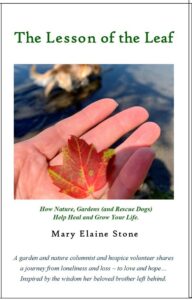
Lesson of the Leaf Cover Mock-up
Brother Bill’s Lesson of the Leaf
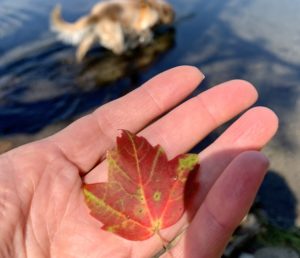
Bill said, “Go to that water near you and find a leaf; watch it maneuver through the current slowly, beautifully, and serenely.” None of us has control over the current, a parallel to the ebbs and flows in our lives. Our goal is to trust, let go, and live calmly and serenely, rather than resist the flow like a leaf in the water.”
Thank you for allowing me to share a bit of my personal story. I love hearing yours and how the wisdom of nature and gardens helps heal and grow your life. You can leave a comment below or email me at AskMaryStone@gmail.com.
We are growing through the seasons of life. No matter what season. There is so much to gain by sharing the wisdom from the Garden of Life, and I am honored that you choose to visit me here each week.
Thank you, kind readers and listeners, Mary Stone


