



Hello, fellow lovers of all things green,
Winter has a quiet way of revealing what other seasons hide. When snow blankets the landscape, long shadows stretch across the white canvas, turning ordinary scenes into something almost sacred. Recently, while my brother Rick was visiting, I found myself admiring those shadows—right up there with the delicate ice crystals on the windows. Shadows even guide how I think about garden design. Yet not all shadows feel the same.
Peter Pan, Jung, and the Shadow Within

 Now that the dust has settled from my life partner moving out his things, I’ve felt the heart-tugs of the shadows left behind. The grief is gentler than in the early days since his departure, but sadness lingers. It makes me wonder: How can some shadows feel beautiful while others feel heavy?
That question brings me to Peter Pan. You may remember the adventurous boy created by J. M. Barrie who could fly and never grow up. In the story, Peter’s shadow becomes separated from him when he leaps from the nursery window. Later, he tries to reattach it with soap, but only Wendy’s careful needle and thread can make him whole again. Peter responds with pride—“Oh, the cleverness of me!”—yet the tender truth remains: a lost shadow longs to belong again.
Psychiatrist Carl Jung offered another way to understand this longing through the idea of the shadow self—the hidden parts of our nature we tuck away. Fears, anger, selfishness, and even creativity can live there. When ignored, they may surface as blame or self-sabotage. But when gently acknowledged, they can become sources of wisdom and peace.
When Shadows Stir the Heart
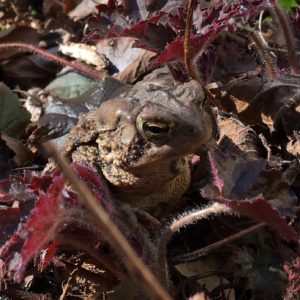
I think of this as a neglected garden bed. During my mother’s final years, my garden went untended, and I felt ashamed—until a small toad appeared during a cleanup, as if to say, tend to things when you can. Beneath the neglect, life was still waiting. With loosened soil, light, and nourishment, renewal returned. Even the places we neglect or abandon can bloom again.
Across cultures, shadows have been seen as more than the absence of light—sometimes companions of the spirit, echoes of the soul walking beside us. To me, a shadow feels faithful, shaped by the light of our generous sun, which gives life to our world without asking anything in return.
Often, while walking along the road with Jolee, I notice our shadows beside us and think of the shadows Ellie and I once cast together. Love leaves outlines that linger.
And then there are moon shadows—my favorites of all. I remember cross-country skiing beneath a full moon, the snow glowing softly, each movement traced in silver. Moon shadows feel quieter, gentler… like whispers of hope.
What Gardens Teach About Light and Shade
Shadows shape our gardens, too. Pergolas and trellises cast patterns that create intimacy in small spaces and structure in large ones. Light and shade bring depth, protect plants from scorching sun, define outdoor rooms, and create a mood—mystery balanced with calm. Even garden lighting, when used thoughtfully and turned off for wildlife at night, becomes part of this dance between brightness and rest.
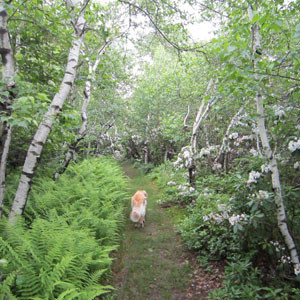
Miss Ellie Mae at the Top of the World
Understanding light also guides plant health. Catalog terms can be confusing. Part sun and part shade both mean four to six hours of direct light, yet part shade prefers morning sun and afternoon protection, while part sun tolerates stronger rays. Full sun offers six or more hours of direct light. Dappled shade—like sunlight filtered through fluttering birch leaves—creates one of the gentlest environments of all.
Paper birch, Betula papyrifera, once common, is harder to find now due to borers. Still, I cherish a healthy stand on what I call the Top of the World at Camelback Mountain in Pennsylvania. I haven’t visited in a while. Perhaps that, too, is a shadow waiting for light.
Full shade is fewer than two to four hours of direct sun. But even there, beauty thrives so peacefully. Each morning, when the sun peeks through the woods and casts long shadows across snow, fallen leaves, or returning ferns, I think of it as God winking—a quiet reassurance at the start of the day.
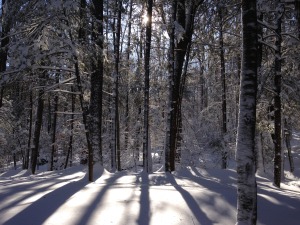
‘Hope’
The Art of Mother Nature.
Photo taken by: Mary Stone
Why Shadows Point Toward Hope
A photograph I titled Hope, from January 2015, hangs above my desk. I took it weeks after my brother’s passing, though I didn’t recognize hope at the time—only beauty after a winter storm. About a year later, I understood. The moment itself was hope.
Now, rather than focusing on loss, I cherish what once was. My brother’s love feels like a shadow that never leaves. The same is true as I grieve the end of a long relationship—sadness resting beside gratitude for shared years.
Recently, a dear client named Tara wrote to tell me she enrolled in the Rutgers Master Gardener program after letting go of a 36-year career in physical therapy due to health changes. Painful, yes—but honest. She said a January episode helped her release what no longer suited her and embrace what does. I know she will bring beauty to many gardens.
Her courage reminds me of a conversation at a hospice luncheon years ago. A woman named Suzanne said winter was her favorite season because, without leaves, you can truly see a tree’s personality—its twists, zigzags, and sculptures revealed in stillness. And yes… the shadows in snow. Even moonshadows.
Moonshadow, Memory, and Quiet Resilience
Cat Stevens once wrote of being “followed by a moonshadow,” inspired by seeing his shadow in moonlight far from city lights. The song carries a quiet message of resilience—accepting change and trusting that loss may also bring release.
But what if a shadow isn’t chasing us? What if it is walking beside us— proof that light is still present, even when we cannot see the source?

The shadow of Bill’s stones
Perhaps that is where all these threads meet:
Garden shadows.
Heart shadows.
Moon shadows.
Each reminds us that light and darkness are not enemies, but partners—revealing depth, meaning, and grace.
So if you find yourself in a shadowed season, take heart. Look closely. There is beauty outlining the snow. Structure forming quietly in the garden. Hope following you home in the moonlight. And maybe, just maybe, the shadow is not the end of the story— but the gentle knowing that light is still shining.
Garden Dilemmas? AskMaryStone@gmail.com or tune in on your favorite Podcast App.
Sharing these reflections aloud felt especially meaningful to me. Enjoy more of the story in this week’s podcast…
Related Podcast and Posts you’ll enjoy:
Groundhog Day- Ancient Origin and Accuracy – Blog Post / Ep 192 Groundhog Day – Ancient Origin and Accuracy
Keeping Lighting Pollinator-Friendly –Blog Post / Ep 123 Keeping Lighting Pollinator-Friendly
Winter Season of Growth – Blog Post / Ep 84 Winter Season of Growth


