


Hello, fellow lovers of all things green,
Last week, I shared thoughts about finding belonging in the Garden of Life. This week, a native plant, a conversation with a dear client, and a folk song about a crooked tree reminded me that sometimes what appears out of place may have a purpose we cannot yet see.

Mimi proudly carries the zinnias she selected for this year’s garden. Some of the best garden lessons grow from the conversations shared while tending them.
For the past several years, I’ve helped Mimi tend her small foundation garden in the historic village of Hope, New Jersey. Walking through Hope feels a bit like stepping back in time, with its beautiful old homes, mature trees, and rich Moravian history.
Each spring, I tidy the garden and plant the annuals she selects. This year’s lineup included cheerful lantanas in shades of yellow and peach, miniature roses, giant zinnias, colorful coleus, and a few other seasonal favorites.
A Garden Tune-Up Becomes Bigger

What started as a routine garden tune-up turned into nearly thirteen hours of cutting, digging, and hauling spiderwort.
What I expected to be a six-hour garden tune-up turned into nearly thirteen hours spread over two days. The culprit? Spiderwort, which is a funny name, isn’t it?
It gets its unusual name from the thread-like sticky sap that oozes when the stems are cut. When it hardens into silky threads it resembles a spider’s web. The name is also attributed to the fuzzy flower buds and stems, which feature fine hairs resembling a spider’s nest, especially when covered in morning dew.
Spiderwort is a native plant with many admirable qualities. There’s Virginia Spiderwort (Tradescantia virginiana) and Ohio Spiderwort (Tradescantia ohiensis). It supports pollinators, tolerates difficult conditions, and produces lovely flowers. It absolutely has a place in gardens, just not in Mimi’s garden, at least anymore. It had taken over entire sections of the planting bed, swallowing neighboring perennials.
The peonies had nearly disappeared. The Shasta daisies were so crowded out. Beneath the surface lay a tangled network of roots that seemed determined to outlast me.
Day one involved weeding, pruning shrubs, and cutting the spiderwort down.
Day two involved digging. And digging. Yanking and pulling. And more digging, yanking, and pulling.
Using my trusty Versa-Hoe from A. M. Leonard, which works like a hoe but has a sharp hook on one end that lets me cut through the web and scoop out what I tackled. I survived the wrestling match. But spiderwort had home-court advantage; no wonder my back grew sore.
The Right Plant in the Wrong Place
I loaded the roots and debris into my oversized garden tarp, the one that looks a bit like Santa’s sack when cinched closed. Mimi kindly helped me jockey it into my truck.
And here’s where the story gets interesting.

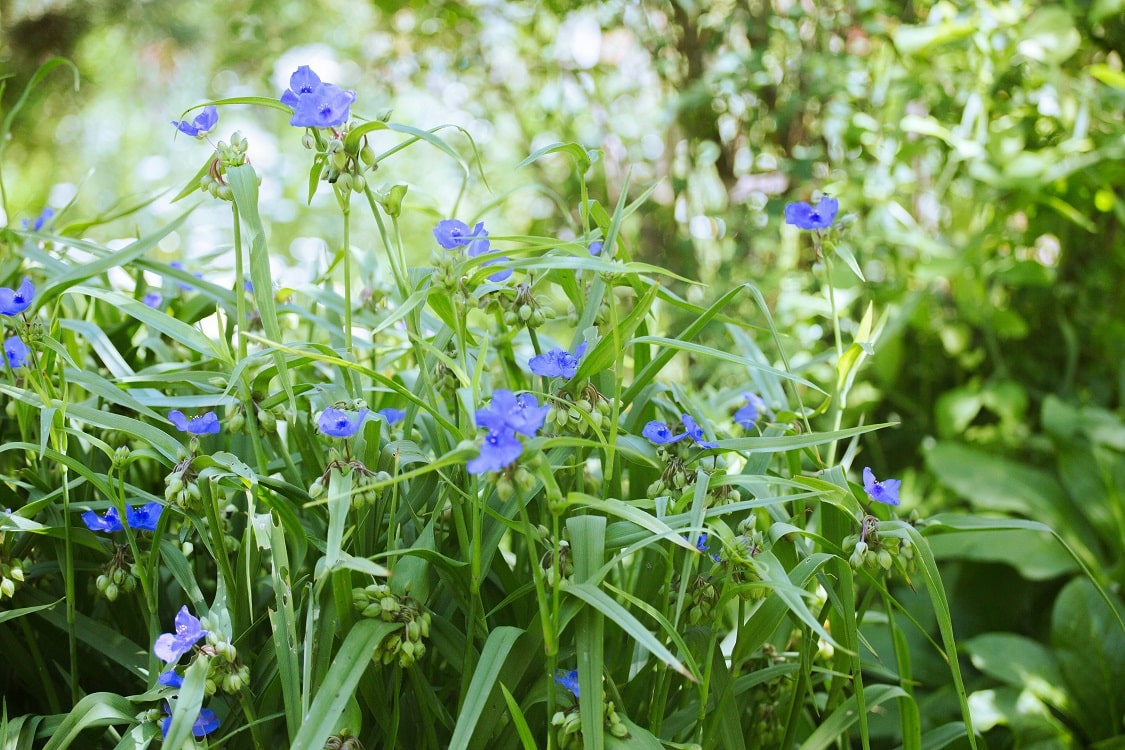
Native spiderwort (under invasive privet) supports pollinators and has many virtues, but it can swallow neighboring perennials.
The very plant that had become such a nuisance in Mimi’s front foundation garden may be exactly what I need in a sunny, boggy area of my own property where invasive weeds have been gaining ground.
What was a problem in one place might become a solution somewhere else.
That thought stayed with me.
Isn’t that often true in our lives?
Conversations from Mimi’s Porch
One of the joys of working in Mimi’s garden is that she sits on her porch while I work, and we talk.

Mimi’s annuals are just getting started, but the garden is ready for summer’s next chapter.
We talk about gardening. We talk about life. We talk about hospice.
Mimi spent years caring for patients as a nurse. During one conversation, she shared a story about Joanne, a clergy member with Karen Ann Quinlan Hospice, who would visit a patient living with dementia.
One day, while Joanne read from a children’s book about Jesus, family members sat nearby. The patient, who typically slept through most visits, became alert, opened her eyes, and seemed to know her family for the first time in a long time.
“It was so special,” Mimi said.
Lessons from a Crooked Tree
As our conversation meandered through life’s twists and turns, it led me to think about a song my hospice music partner and dear friend, Ken Roberts, recently introduced me to: Crooked Tree by Golden Highway and Molly Tuttle.

A crooked tree in my woods. Its unusual shape reminded me of the song “Crooked Tree” and of the ways life’s unexpected twists become part of our purpose.
The song tells the story of a crooked tree growing among straight trees in a forest. When loggers arrive, the straight trees are harvested and carried away to be made into lumber.
The crooked tree remains. It doesn’t fit the mill machine. So, it stays exactly where it is—growing, living, and free.
The song reminded me that many of us travel roads we never expected to take.
Plans change. Relationships end. Life takes turns we never would have chosen.
Mimi and I have traveled different paths, yet we share a common thread. Neither of our journeys unfolded according to plan.
And yet here we are. Grateful for the people who continue to walk beside us. Grateful for the beauty that surrounds us.
Living alone perhaps, but not alone at all. We are part of a much larger forest.
A Leaf on My Shoulder
Thinking about crooked trees brought me back to a memory I shared a few years ago in a post, The Fall of the Leaf, and in Podcast Episode 83, both of which feature the prologue of The Lesson of the Leaf, my book in progress.
On a windy autumn day, leaves swirled all around me while on a road walk with Jolee. I found myself hoping one would land in my hand, but I stopped to take a few photographs.

Moments before a single beech leaf landed on my shoulder. Sometimes the gift is not the photograph itself, but the memory it holds.
Just as I heard my brother Bill’s familiar voice in my mind, reminding me to stop fiddling with my phone and enjoy the moment, I put the phone away. As if on cue, a single beech leaf landed on my shoulder and stayed there. It made me chuckle.
I tucked it into my pocket and later placed it inside a mock-up of The Lesson of the Leaf.
Some people call those moments coincidences.
I prefer to think of them as little reminders. Not answers. But reminders that we are connected to something larger than ourselves.
The Lesson
Spiderwort doesn’t belong everywhere.
But it belongs somewhere.
A crooked tree doesn’t fit into the mill machine.
It survives in a forest where the straight trees are harvested.
The twists in our lives are not flaws at all.
They are part of what makes us uniquely suited for the purpose we are here to fulfill.
Maybe what sidelines us today becomes exactly what we need tomorrow.
And with that thought, there is hope.
Garden Dilemmas? AskMaryStone@gmail.com or tune in on your favorite Podcast App.
 Prefer to Listen?
This story is also a feature in this week’s episode of Garden Dilemmas, Delights & Discoveries, with additional reflections from the screen porch:
Related Podcasts and Posts:
The Fall of the Leaf – Blog Post about the Prologue to The Lesson of the Leaf
Episode 83. The Fall of the Leaf
Growing Belonging in the Garden of Life – Blog
Episode 255 – Growing Belonging in the Garden of Life
Overview of The Lesson of the Leaf – Blog
Episode 180: Overview of The Lesson of the Leaf
Episode 253 Healing Beneath the Mayapple: Skunk Cabbage Wisdom
Link to Molly Tuttle & Golden Highway’s song – Crooked Tree


