


Hello, fellow lovers of all things green.
I recently received the New Jersey Tree Survey in the mail. It always makes me smile — and pause at the irony. A large, printed document arrives, urging us to save trees on paper made from trees. Still, its arrival feels like an invitation to reflect.
Why Trees Matter
The survey comes from the Arbor Day Foundation. Over the years, its messaging has evolved. What once felt like a simple demographic questionnaire now highlights something I genuinely appreciate: how trees support mental health and community well-being, provide wildlife habitat, clean our air and water, and offer beauty and shade. The letter even creates a sense of being “chosen,” noting that only a small percentage of residents receive the survey. Yes, it’s a marketing tactic — but one rooted in a cause I believe in. Behind the fundraising is the truth—Trees matter. They matter deeply.
Some of the survey questions made me smile: Do trees reduce stress, improve mood, inspire creativity, encourage mindfulness? Of course they do. I can’t imagine many people checking the box that says trees have no impact on well-being. Trees are beautiful. Trees are purposeful. Trees belong.
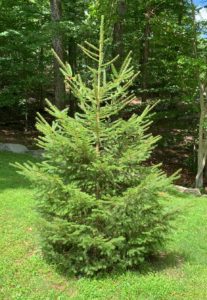
Norway Spruce (Picea abies)
Norway Spruce vs. Native Trees: What to Consider
One gift offered with your donation this year is ten fast-growing Norway spruce (Picea abies). They are not native here — originating in northern and eastern Europe, and they’ve become invasive in parts of North America, outcompeting native plants. I wish the Arbor Day Foundation offered native species instead, such as our beloved Eastern hemlock (Tsuga canadensis). Still, Norway spruce has value. They provide year-round shelter for birds, act as windbreaks, absorb carbon, and grow quickly into privacy screens.
When I drive toward Newton, I pass a large home with a sweeping lawn lined with tiny spruce trees in contrived rows. They look a bit like rows of toy soldiers standing at attention. The owners lovingly mow around each one. I suspect the trees came from the Arbor Day Foundation. Even contrived beginnings will mature into meaningful purpose. One day, they’ll grow into a living wall, softening the busy road beyond.
The Arbor Day Foundation and the Power of Planting Trees
The survey also asks what we value most about trees. I can’t imagine anyone would check the box that says: “There is nothing I value about trees.” Even those without yards benefit from the quiet grace trees offer simply by existing among us.
Evaluating charitable organizations can feel daunting. We want to know if our donations make a difference. Independent nonprofit evaluators such as Charity Navigator show that the Arbor Day Foundation directs a substantial portion of its resources toward its core mission of planting trees and supporting forestry programs. Like many large organizations, it also invests heavily in fundraising — but notably, the Arbor Day Foundation is transparent about its finances and is a 501(c)(3) nonprofit — meaning donations are tax-deductible, unlike other well-known conservation groups.
While I’m not suggesting membership in the Arbor Day Foundation, I’m promoting planting and nurturing trees. Even when leafless, roots are quietly working, preparing for the subsequent unfolding of growth— helping to purify and protect our world.
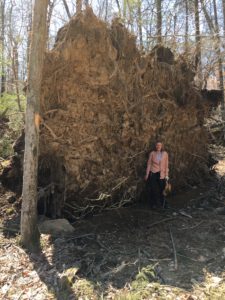
One of a dozen fallen hemlocks from the nor’easters
Hope in the Form of a Tree

The rebounded Beech Tree after 8 years.
My connection with trees has always been personal, even spiritual. Years ago, a massive Eastern hemlock fell in our woods after a nor’easter. A neighbor cut the trunk so the root ball would flap back into place. Growing beside it, a young beech tree landed back into place.
With great reverence, I brushed away the sawdust of the giant hemlock to reveal the rings of this glorious tree, shallow-rooted in shale near Jacksonburg Creek, where I live. It had stood there for nearly two centuries. Today, eight years later, that young beech tree stands strong — a quiet promise of renewal.
Trees have taught me that growth is rarely urgent. Roots work silently long before branches show change. Forests heal slowly. Seasons arrive in their own time. Beneath uncertainty, beneath noise, beneath fear — something steady is still growing.
I hope today’s reflection reminds you, as it reminds me, that hope sometimes takes the form of a tree.
Garden Dilemmas? AskMaryStone@gmail.com or listen on your favorite Podcast App.
There’s more to the story in theGarden Dilemmas Podcast:
 A Previous Post You’ll Enjoy:


