


Hello, fellow lovers of all things green. This past winter left its mark, but the garden is slowly healing after winter’s extremes.
Heavy snow, stretches of single-digit temperatures, and winds brought more damage than usual. Now, as I walk through the garden, I see the evidence—winter burn, broken branches, plants struggling to find their footing again.
And yet… I see signs of hope.
Winter Wounds and Signs of Resilience
A large holly, here long before I arrived, was recently transplanted. She is a beauty, berries and all, but her leaves are almost black from the winter winds. And yet the lower branches are still green, the ones covered by snow. A gift that winter gave.

Hellebores from a dear friend’s garden—a reminder that beauty returns.
Transplant shock is inevitable in such moves, which is why I rely on a seaweed extract to support recovery. I’ll continue feeding all fall transplants every few weeks as spring unfolds, helping their roots regain strength.
Nearby, hellebores gifted from my dear friend Marty Carson’s garden are blooming—soft pink faces emerging through last year’s leaves. I’ll wait to trim back old foliage until beneficial insects have had a chance to emerge.
Even in cleaning things up, timing matters.
Spring Pruning Tips
Spring brings pruning decisions.
A helpful rule of thumb:
- Prune evergreen shrubs and non-flowering deciduous shrubs in early spring
- Wait to prune flowering shrubs until after they bloom
And resist pruning late in the season. New growth won’t have time to harden off before winter, which can lead to damage.
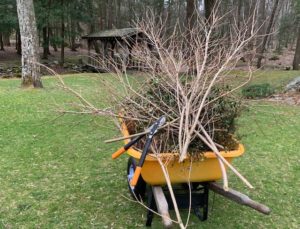
Rejuvenation pruning in action—thoughtful cuts for long-term health.
The smokebush (Cotinus coggygria) is calling for attention. When rejuvenating, I selectively reduce the canopy by about one-third, cutting just above growth nodes or removing entire limbs cleanly at the branch collar.
Careful, thoughtful pruning keeps them full and thriving.
I also learned from one of you that some are highly allergic to smokebush foliage—something I hadn’t known—and that’s a good reminder to wear gloves and long sleeves when tending unfamiliar plants.
Giving Plants Room to Grow
It’s true that when plants are properly spaced, you won’t generally need to prune them.
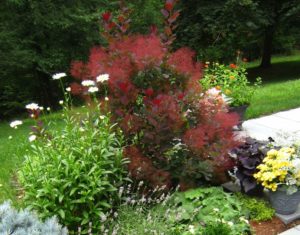
Garden Design by Mary Stone, Stone Associates Landscape Design & Consulting
The rule of thumb in garden design is:
- Space trees and shrubs half their width at maturity
- Herbaceous plants, such as perennials and groundcovers by their width at maturity.
Give plants room to be who they are. However, sometimes we wish to have certain beauties in tighter spots so we can admire them. Then, careful “haircuts” are part of the nurturing.
Playing in the Garden

A bit of early spring play—Mother Earth adorned with forsythia and last season’s golden grasses.
I’ve also been enjoying a bit of early-season creativity.
A beloved Mother Earth face pot, gifted by my very first clients, is adorned with forsythia branches for hair. Forsythia isn’t native, and I wouldn’t plant it anew. But since it’s here, I appreciate its cheerful early bloom. If the branches root, I may plant them along the property edge, where they suit the landscape.
There’s a balance between honoring what is… and choosing what comes next. Though I much prefer the native alternative to forsythia, Northern spicebush (Lindera benzoin), often called “forsythia in the wilds,” with its soft yellow flowers, fragrant leaves, and brilliant fall color.
A staple decoration in Mother Earth’s headdress is tree branches lassoed into a cross. Pansies provide a colorful accent above the bangs of Japanese forest grass (Hakonechloa). While not a native plant, I adore the tawny gold color when dry and how the new growth pushes out the old —wisdom for all of us.
Carex, commonly called sedge, is a native option, though they tend to stay evergreen, so I’d miss the golden hair highlights of fall and winter.
Small Wonders of the Season

Ferns emerging in clusters—spring’s reminder that life returns, one unfurling at a time.
As I walk through the woods, I notice ferns tightly coiled, ready to unfurl. There’s something magical in that perfect spiral. Like a delicate pastry waiting to open.
I’m planning to add a native sedge (Carex pensylvanica) to the woodland, hoping it will naturalize and perhaps outcompete invasive stilt grass.
Elsewhere, volunteer trees—white pine and young hemlocks—remind me how life finds its way, often from unexpected places.
Reflections from the Garden
As I move through the garden, noting emerging peonies and cutting back last season’s sturdy Joe-Pye weed stems to turn into sweet pea trellises, I find myself reflecting on something deeper.
This healing in the garden after winter reminds me that it’s easy this time of year to focus on what needs fixing, what didn’t survive, what must be moved, and what needs tending.
We do the same in our lives. Especially in difficult seasons, we can become consumed by what feels broken or missing. For me, this season marks the absence of loved ones. And yet it also brings gifts—a church visit with neighbors who have become friends, and the celebration of my singing partner and dearest friend Ken’s birthday on Easter Sunday.
There is always something to be grateful for.
Perhaps the garden reminds us not to rush toward fixing everything. Instead, we take one small step at a time. We tend what we can. And we notice what is already beautiful. And in doing so, something within us begins to heal and grow.
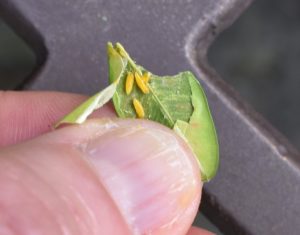
Boxwood Leaf Miner Larvae, also known as Hotdog Flies
A Little Laughter Along the Way
Before I sign off, I have to share a garden moment that still makes me smile. A former neighbor once told me her boxwoods were hissing. She called the cause “hotdog flies,” far more memorable than their proper name, Boxwood Leaf Miner.
And sure enough… if you listen closely at the right time of year, they do make a faint fizzing sound. Not exactly what you’d expect from an evergreen, it’s a reminder not to take things too seriously. Even in the midst of pests, pruning, and winter damage, there is room for curiosity—and even laughter.
The Garden of Life
Gardens, like life, aren’t meant to be perfect. They are meant to be lived in… experimented with… sometimes puzzled over.
Sometimes we are tending wounds.
Other times, we are making hairdos out of forsythia branches.
Both matter.
Maybe especially the second.
Because healing, in gardens and in life, comes not just from what we fix, but from what we allow ourselves to enjoy. And so today, may I suggest you take time to play.
Garden Dilemmas? AskMaryStone@gmail.com or tune in on your favorite Podcast App.
Prefer to listen? 
This story is also shared in this podcast episode, with a few additional reflections from the screen porch.
Links to related Podcasts and Posts:
Blog Post: Rejuvenation Pruning & Smokebush
Ep 155. Spacing Plants and Splendid Smokebush
Blog post: Remedies for Boxwood Leaf Miner


