


Hello, fellow lovers of all things green,
Last week, I shared the sad news that the Karen Ann Quinlan Home for Hospice in Fredon, NJ, will close on November 14, 2025. As you can imagine, my final visits as a volunteer come with a swirl of emotions.
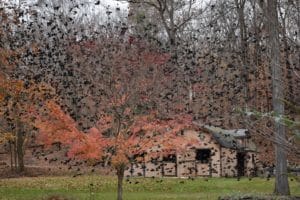
On Friday, while chatting with the angel-caregivers, a large flock of grackles lifted from the farm field beyond the living-room windows—a spectacular sight. Leave it to retired United Airlines Captain (my singing partner) Ken Roberts to wonder: “How do they never collide?” That’s an intriguing question!
The Grackle Ballet: A Nature Spectacle
I haven’t yet seen the swarms arrive on my property this season, but I adore the arresting sound of thousands of grackles descending into the yard—squawking and feeding for a few minutes before rising in a synchronized wave. Their take-off sounds like the soft whir of a helicopter—glorious in its volume and unity. It’s a stunning reminder that there’s power in numbers.
“Common Grackles move through our area this time of year, sometimes by the many thousands,” said my birder-buddy Dennis Briede, Stewardship Manager of the Land Conservancy of New Jersey. “They like to raid corn-fields, too.”

Photo by Blaine Rothauser
Feeding on fall remnants isn’t so bad—but grackles are also known for snagging newly-planted corn and seedlings. Because of this, they’re sadly deemed “nuisance birds” under state and federal law. Though culling is regulated, millions have been killed.
The Common Grackle (Quiscalus quiscula) is about the size of a mourning dove, with a long tail, yellow eyes, and a black beak. From afar, they appear solid black. But up close, they shimmer with iridescent purples, blues, and greens—like ornaments filling the bare branches where leaves once were. They nest in colonies of up to 200 and often migrate with other blackbirds.
There’s a fascinating article on the University of Delaware website titled Blackbirds, Fly. It talks about a mixed super-flock of millions of blackbirds—common grackles, red-winged blackbirds, brown-headed cowbirds, and starlings—that choose Churchman’s Marsh, DE as their winter home. Depending on the food source, they’ll travel to Chester and Lancaster counties, PA, to feed, then return to the marsh to roost.

Photo by Blaine Rothauser
Flight Dynamics & Human Life Lessons
The massive waves of birds recall Alfred Hitchcock’s classic thriller The Birds—about millions of birds becoming violent killers of man and beast. Common grackles are not considered vicious, although, as social as they are, they defend their nests and attack other birds. I also read they’re inventive foragers—snagging worms from robins, stealing eggs from nests, and scoffing down smaller adult birds.
But back to Ken’s question: How do they never collide?
It’s fascinating how grackles and other flocking birds manage their flight. Scientists describe three key strategies: separation, alignment, and cohesion—concepts that offer wisdom for humankind, too.
-
Separation: They maintain a safe distance, adjusting speed and direction based on the six or seven birds closest to them—never losing awareness of their neighbours.
-
Alignment: When threatened, they instinctively shift slightly to the right and rise higher, all at once, moving as one.
-
Cohesion: Despite appearances, there isn’t a single leader. Each bird makes its own choices, yet together they move as a single, cohesive unit.
There is Strength in Unity
Their strength is in that unity—it’s hard for predators to single one out among thousands. Their collective awareness becomes their protection. Occasionally, collisions occur—especially during chaotic take-offs—but harm is minimal. Larger, less agile birds are more prone to run into each other; yet they quickly regroup and continue—another lesson for us.
Watching their synchronized flight, I couldn’t help but think about how often we do the opposite of what Mother Nature teaches us. Instead of maintaining respectful distance, aligning our actions with others, and moving cohesively toward shared well-being, we scatter in competing directions. Grackles don’t fly from ego or control. They respond instinctively to the needs of their flock—to protect their young, their food, and their future generations. Their movements are guided not by dominance but by connection.
 What If Humans Flew in Flocks?
Wouldn’t it be something if we humans could do the same—fly in the same flock, respecting space yet working in harmony to safeguard our families, our communities, and our world? Maybe the grackles are here to remind us that strength and grace come not from going it alone but from trusting the rhythm of togetherness—the quiet awareness that, while each bird moves on its own, the sky is shared by all.
Reflections & Parallels: Hospice, Gardens and Life
Watching those grackles makes me think of the parallels with hospice—the caregivers, like the birds, work in quiet coordination. Each tending their part, yet guided by something larger—compassion, trust, and love. Maybe that’s what harmony really is: awareness of one another, a respect for our shared space, and the willingness to lift each other higher when the winds shift.
If only we could live that way more often—in our families, our neighborhoods, our world—we might find that unity isn’t uniformity. It’s the dance of individuality within a shared connection. And as this season of letting go continues, may we hold onto the image of a sky filled with wings shimmering together, reminding us that even in endings, there is beauty, and the possibility of flying forward in grace.
Garden Dilemmas? AskMaryStone@gmail.com and your favorite Podcast App.
Listen In & Join the Conversation
There’s more of the story in the Garden Dilemmas Podcast:
About Blaine Rothauser, Natural History Photographer, whose magnificent images you see here, are available to decorate your world.
Related Post and Podcast:
Promises That Live Beyond Seasons – Blog Post
Episode 228 Promises Live on Beyond Seasons and your favorite Podcast App.
Article on the University of Delaware website titled Blackbirds, Fly.


