


Hello, fellow lovers of all things green.
One of my favorite parts of landscape consulting is solving garden mysteries. Sometimes the answer is obvious. Other times, what appears to be the culprit turns out to be innocent. Such was the case during a recent garden tune-up when a seemingly healthy rose revealed a surprising secret beneath the mulch.
The Rose Mystery
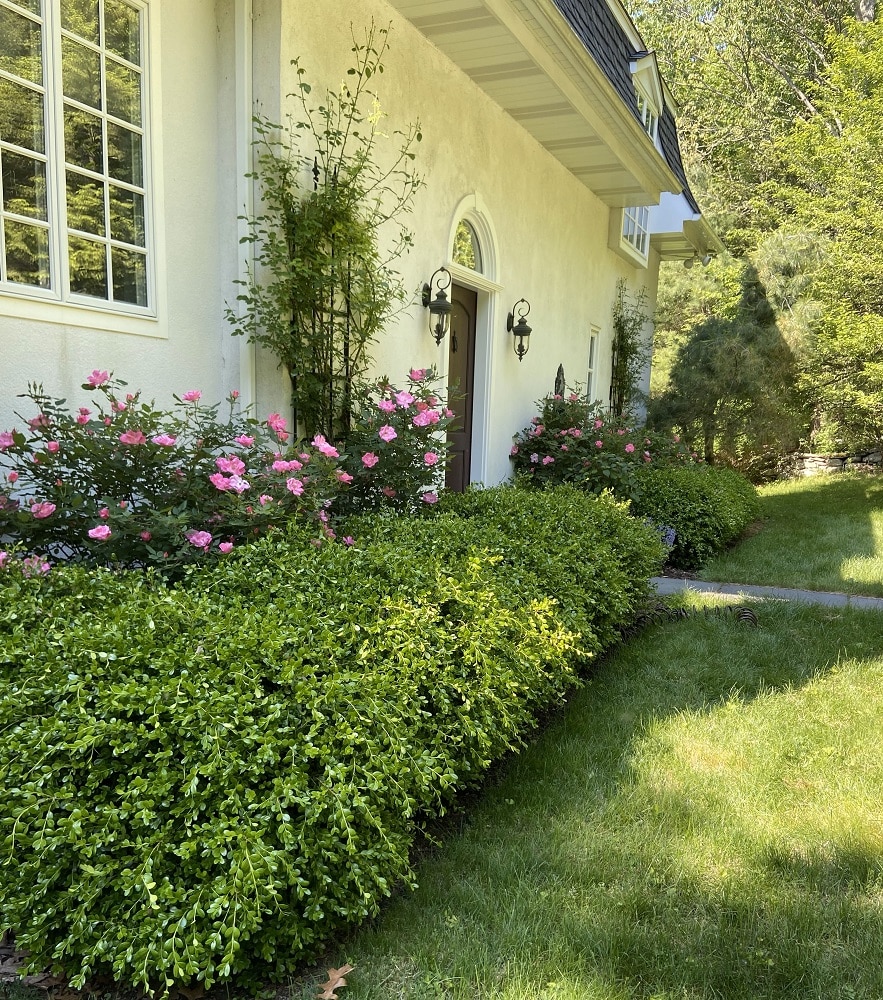
During a garden tune-up at the home of my longtime client Pat, the gardening team noticed that one of the roses along the foundation was loose in the ground. I had planted that rose the previous summer to replace another one that died after its roots were gnawed to bits. We assumed chipmunks were responsible. There are plenty darting around the adjacent rock wall, looking almost too adorable to accuse of wrongdoing, almost that is. Chipmunks can do a lot of damage.

From the surface, everything appeared healthy. One loose rose revealed a mystery hidden beneath the mulch.
What made the new rose especially puzzling was that earlier in the season it had pushed out a profusion of flowers. From above ground, it appeared to be flourishing, but when the plant lifted easily from the soil, we discovered virtually no roots remained.
It struck me that the rose had used every bit of stored energy it had to bloom despite what was happening beneath the surface.
Andrew, the lead gardener, mentioned the Juicy Fruit gum remedy that my dear friend and design colleague Marty Carson swore by. Andrew worked in Marty’s garden and knew the story very well. I shared the tale in Chipmunk Remedies and Legends. (I love the legend of chipmunks and you will too – link below). I can still hear Marty’s telling of how-to.
“You drop the old-fashioned Juicy Fruit gum sticks into the chipmunk holes by the boulder wall. They’ll eat the gum, and their innards will bugger up.”
“Not exactly humane,” I replied.
Even so, curiosity got the better of me, and I gave it a try.
The punchline? My chipmunks apparently loved Juicy Fruit. I suspect they invited their friends to the party. Maybe they’ll croak from rotting teeth. Marty also suggested an outdoor cat, but that was before Miss Jolie arrived on the scene, and she’s a pretty good chipper.
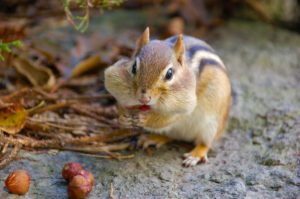
Our first suspect looked almost too adorable to accuse.
Chipmunks…or Something Else?
After I visited Pat’s garden, I went down a research rabbit hole-or should I say, vole hole? Chipmunks certainly dig burrows and can disturb roots while stashing food, but when a plant lifts from the soil and its roots appear chewed off, voles are more likely the culprit. The soft ground beneath Pat’s shrubs provided another clue. Walking through the bed felt spongy, even though there were only a few inches of mulch.
Andrew assumed the softness came from chipmunk tunnels, but voles create a network of shallow runways beneath grass mulch and leaf litter; their tunnels are closer to the surface than chipmunks and undermine it enough to make the ground feel squishy underfoot.
Moles vs. Voles
A side note here: voles and moles are often confused. Unlike moles, voles are rodents. They resemble stocky little mice with short tails, small eyes, and ears partially concealed by fur. They eat grass, roots, bulbs, bark, and other plant materials, and they can sure damage lawns and ornamental plants, and strip bark or sever roots from trees and shrubs.
Moles are insect-eating mammals with powerful shovel-like front feet designed for digging; they feed primarily on earthworms and grubs, slugs and other soil-dwelling creatures, not rose roots. And moles are often blamed for plant damage because their tunneling disturbs soil and can expose roots.
Voles may even use abandoned mole tunnels as underground passageways, leaving the mole to take the blame for the damage, but both of these critters serve a purpose. Moles help turn and aerate soil while feeding on insects, and voles are an important food source for owls, hawks, foxes, snakes, and other predators. They belong in nature. We would merely prefer they not eat the roots or bark of trees and shrubs.

The rewards of thoughtful design and attentive care are reflected throughout Pat’s beautiful garden.
Protecting Precious Roots
I suggested that Pat place a replacement rose in a large container. The boxwood hedge in front of the roses is now knee-high, so you wouldn’t even see the pot. Yes, it may require extra winter protection in our climate, but at least its roots would be beyond the reach of the underground dining committee.
Then I learned about hardware cloth baskets. You can make one from quarter-inch galvanized hardware cloth by cutting a generous piece of mesh and shaping it into a wire bowl. Fold the sides upward, overlap and secure the corners, and leave the top open. Place the basket in the planting hole and plant the rose inside. For a shrub or rose, the basket might be 18 to 24 inches wide and 12 to 18 inches deep.
There are ready-made bowl baskets also available. If it’s in a three- or five-gallon nursery container, I would suggest you get a 10-gallon basket. That way, the rose has plenty of room to grow. The rose’s fine roots can eventually extend beyond the mesh, but its crown and central root system will receive valuable protection.

Products like these may solve one problem while creating another by putting predators and pets at risk.
Natural Solutions First
I also came across bags of mole and gopher poison at a farm supply store. I wouldn’t buy it, though, because poison introduces an entirely different dilemma. They can expose children and pets if the bait is not securely contained.
Depending on the active ingredient, a poisoned animal may also be eaten by an owl, hawk, fox, or snake, or a domestic pet, creating the possibility of secondary poisoning. Essentially, using poison to eliminate voles could harm the very predators that naturally help control them. Every chemical solution has consequences. For Pat’s rose, a wire basket feels like a far more sensible approach, protecting the plant rather than negatively affecting our environment.
Another Garden Mystery
The missing rose roots weren’t the only mystery in that garden tune-up. Pat has a beautiful weeping white pine growing near the house, and the canopy looked very thin, and white flecks and streaks marked the trunk. At first, I wondered whether disease or insect infestation was causing its decline. A closer inspection showed mostly green needles without the widespread spotting, banding, or browning we would expect from a serious needle disease.

The thinning canopy initially suggested disease or insect damage.

The white streaks proved to be dried pitch from an old pruning wound rather than evidence of a new disease.
The white streaks appeared to be dried pitch flowing from old pruning wounds. The tree had formed callus tissue around them and had been compartmentalizing those injuries for years. I believe the pine was impacted by the especially dry conditions rather than disease because after the significant rainfall, it started looking noticeably better.
As with the disappearing rose roots, the first impressions didn’t tell the whole story. We had to look more closely.
Beneath the Surface
Garden dilemmas resemble the setbacks in our lives. We have little control over many of them.
We cannot change the instincts of voles, moles, or chipmunks. We can’t command a plant to thrive when its roots are compromised. We can’t control the weather or decide which trees will endure drought, storms, or disease.
One of the greatest lessons I’ve learned in the garden—and in life—is that people and plants are not ours to fix.
We can water.
We can nurture.
We can encourage.
We can even build little wire baskets around tender roots.

After soaking rains, the pine began recovering, reminding me that first impressions don’t always tell the whole story.
But we can’t force another living thing to become something it isn’t capable of becoming.
I can’t change Jolee’s instincts.
As I dictated these thoughts while walking with Jolee, she suddenly spotted a chipmunk near the edge of the farm field and lunged so quickly she nearly knocked me off my feet.
Chasing chipmunks and squirrels seems to be one of her life’s greatest purposes.
When I see the “chipper” first, I can remind her she’s on a leash.
But I can’t change her instincts.
The same is true in relationships.
We can care deeply.
We can offer support.
We can hope someone will grow or accept help.
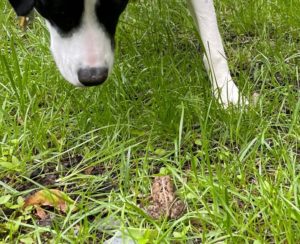
Chasing chipmunks is one of Jolee’s greatest joys. But a toad would do too, if Mom didn’t intervene. Smile.
But we can’t do another person’s growing for them.
Gardens and nature remind us that what we see on the surface rarely tells the whole story. The answers are often hidden beneath the surface, and the culprit isn’t always what we first suspect.
A flowering plant may be struggling below ground. A tree that appears to be declining may only need rain.
In our own lives, healing often begins when we stop trying to change what we cannot control and instead protect what matters most.
We don’t always get to choose what tunnels beneath our gardens—or in our lives.
But we do get to decide how we’ll tend to our roots.
Garden Dilemmas? AskMaryStone@gmail.com or tune in on your favorite Podcast App.
 Prefer to Listen?
This story is also a feature in this week’s episode of Garden Dilemmas, Delights & Discoveries, with additional reflections from the screen porch:
🌿 Related Posts:
Treasures from a Countryside Garden Tour
Preservation of the Paulinskill – how tree tubes used in habitat restoration inspired another way to protect vulnerable plants from unseen damage below ground.
Sharing Comfort & Perennials , including a heartfelt reflection about ‘The Boy, the mole, the fox and the Horse,’ illustrated and handwritten by Charlie Mackesy.
Related Podcast Episodes:
🌿 Ep. 261 – Treasures from the Warwick NY Garden Tour
🌿 Ep. 185 – Preservation of the Paulinskill: Overcoming Hardships
🌿 Ep. 66 – Chipmunk Remedies and Legends
🌿 Ep. 54 – Sharing Comfort & Dividing Perennials

Klip Dagga (Leonotis nepetifolia)
Garden Detective Update:
A special thank you to Monika for solving the mystery about the unusual plant we admired in Cassie’s garden in last week’s post.
It is Klip Dagga (Leonotis nepetifolia), also known as Lion’s Ear or Christmas Candlestick, a striking member of the mint family native to southern Africa.
Gardeners truly are wonderful detectives, always willing to help identify a beautiful plant.


