


Hello fellow lovers of all things green,
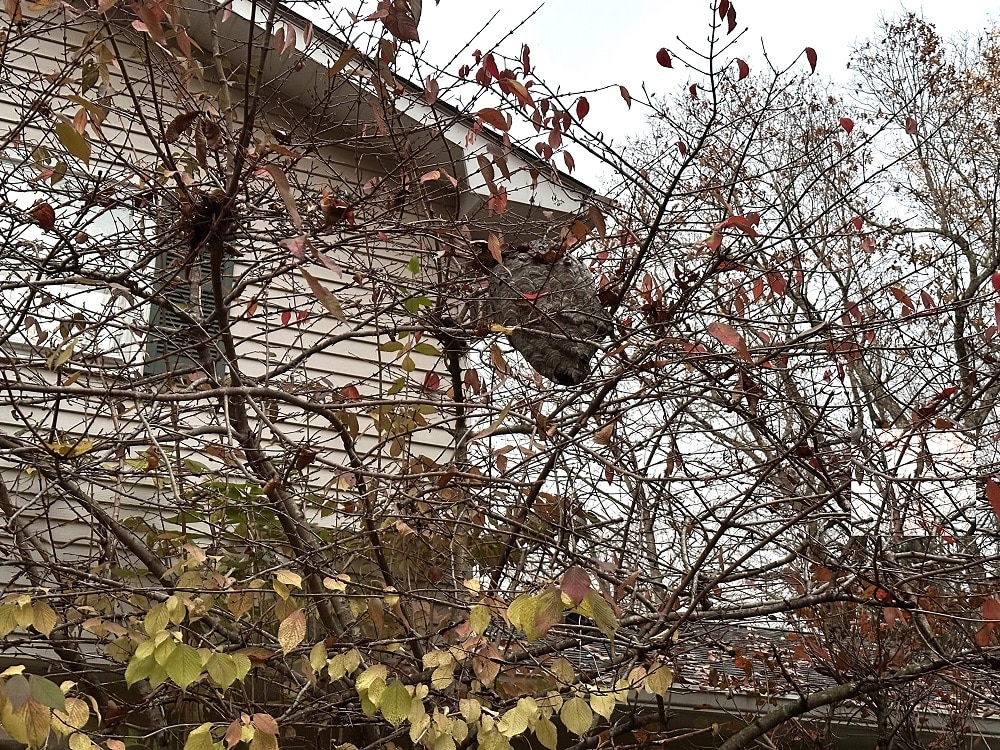
Don’t you love seeing bird nests revealed when leaves fall from trees and shrubs? Well, to my amazement, the oversized Doublefile Viburnum outside my kitchen window revealed a magnificent gray paper nest hidden among its branches. Bald-faced hornets had made themselves at home! Looking closely, you can see the nest’s intricate, layered patterns, almost like a handmade gray piñata. I never imagined such artistry was unfolding outside my window.

Autumn’s unveiling of a summer’s worth of work.
Birds nested in that same shrub this summer, too. I wonder how they and the hornets coexisted, or whether their nesting seasons overlapped. Nature holds so many stories we never witness.
Bald-faced hornets aren’t true hornets.

Dressed in black and ivory rather than the familiar yellow and black. (Photo by Rhododendrites, Wikimedia Commons, CC BY-SA 4.0.)
I didn’t realize until digging into learning more about the bald-faced hornet (Dolichovespula maculata) that it’s actually a yellowjacket, often called an aerial yellowjacket. Penn State Extension explains that these native insects aren’t true hornets. The only true hornet in our region is the European hornet, introduced accidentally.
Unlike the familiar yellow-and-black yellowjackets, which often nest underground, bald-faced hornets build football-shaped nests in trees, shrubs, and sometimes on buildings. They are black with ivory-white markings on their faces, legs, thorax (the middle body section), and abdomens. They’re generally about half to three-quarters of an inch long; the queens are larger. Native to North America, they are found throughout much of the United States.
Nature’s remarkable little builders
Each spring, a newly mated queen emerges from her winter shelter beneath bark, in hollow trees, or other protected places. What a fascinating little builder! She chews weathered wood, mixing it with saliva to make a papery paste, builds a few brood cells, lays eggs, and feeds the larvae mashed-up insects.

The swirling patterns remind me of the grain in a beautifully polished piece of wood.
Can you imagine? She does all that work herself at first. Once her daughters mature, they take over nest building, hunting, feeding, and defense. Yes, daughters! All the worker hornets are female. The males arrive later in the season, primarily to mate with the new queens.
The colony may grow to three or four hundred workers, and the nest can be 24 inches high and 18 inches wide; quite a substantial structure to be hidden from view in a shrub just outside my kitchen window.
Each new layer expands the nursery while the outer shell protects its inhabitants from weather. Inside are tiers of brood cells where the developing young are cared for. And protecting it, they do!
I recall being stung by a few hornets when I was a kid tending my first garden of marigolds—Mary’s Gold, I called them. I can see me now, lying on my stomach, kicking my legs to get them to stop. And they didn’t stop. Unlike honeybees, these wasps can sting multiple times. Fortunately, they’re generally not aggressive away from their nest.
I don’t know for certain what kind of hornets or wasps stung me back then, but I certainly remember the experience!
The many inhabitants of Sara’s viburnum
Good thing I never got to prune my adored viburnum! It was my dear Sara’s favorite nap spot long ago. An angel sculpture sits there now with two tennis balls formerly in play. Sara was a serious ball-aholic, unlike my rescues Miss Ellie and Jolee, though I giggle whenever they’d grab a ball for a toss or two.
There’s something so special about the places our beloved pets favored. Even long after they’re gone, those spots hold memories. And that viburnum has been home to many birds.
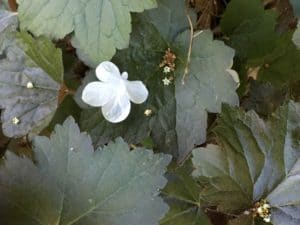
Palace Purple Coral Bells with an angel from above. Enjoy the story Doublefile Viburnum Angels.

Another generation raised in Sara’s beloved viburnum. Enjoy the story Robins of Renewal in the Garden.
I had planted the Doublefile Viburnum eight feet from the house, allowing plenty of room for its mature spread. Per Michael Dirr, the guru of trees and shrubs and author of the Manual of Woody Landscape Plants, Viburnum plicatum tomentosum ‘Mariesii’ grows eight to ten feet tall and nine to twelve feet wide at maturity.
A twelve-foot-wide shrub means it will grow six feet on each side of its center. So, planting Sara’s viburnum eight feet from the house was appropriate, providing a two-foot buffer for wiggle room.
But nature had other plans. Or maybe Sara’s mojo has something to do with it being supersized. So, I limbed it up into a small tree with shade-loving perennials and ferns below. I love the layered look and the shelter it creates for wildlife.
I had planned to prune the shrub this summer to bring its size back into proportion, but one thing led to another, and I never got around to it. What a blessing that was! Imagine disturbing a colony of several hundred protective wasps while cutting branches around their home. Holy moly, that would have been quite a painful garden dilemma!
Bald-faced hornets are beneficial garden guests.

A less-feared side of a much-feared insect. (Photo by Beatriz Moisset, Wikimedia Commons, CC BY-SA 4.0.)
They hunt flies, caterpillars, and other insects to feed their young and visit flowers for nectar, providing some pollination. They can even prey upon other yellowjackets.
Isn’t that interesting? An insect we might instinctively fear is actually helping manage populations of others that can trouble us in our gardens. Bald-faced hornets are native insects, so they belong in our local food web.
Unless a nest is near a doorway, frequently used path, or garden work area—or someone has a sting allergy—they are best left undisturbed. Seek professional help when removal is necessary.
It’s also wise to be especially careful when pruning dense shrubs during the growing season. You never know what might be living among the branches, including our beloved birds.
A magnificent home for only one season
As cold weather arrives, the workers and original queen die. Only newly mated queens survive elsewhere, having found protected places to overwinter. Come spring, each surviving queen begins the process all over again, building a new home and raising a new generation.
While the old nest is never reused, nature doesn’t waste much. Woodpeckers may tear into it in search of remaining larvae, and even bears may raid nests they can reach, drawn by the protein-rich brood inside.
So, what looks like an empty home to us may still provide nourishment to other creatures.
Taking Center Stage
After sustained freezing weather, an abandoned nest can even become a dramatic addition to a large floral arrangement. I once admired one taking center stage among cut flowers in a historic inn’s lobby. I wish I had a photograph to share with you. It was magnificent!
The beautiful gray layers and organic shape complemented the flowers in a way that no manufactured decoration could. If you ever collect one, be certain the colony is inactive, and cut the supporting branches carefully; the paper is delicate.
Last year’s nest remains beneath the eaves of my roof—not so pretty. Protected from the weather, much of it is still intact. While this one is accessible, I’ll leave my new nest where it is. There’s something so lovely about seeing it nestled among the bare branches.
Lessons in shelter and belonging
What an extraordinary amount of work for a home lasting only one season. Yet it fulfilled its purpose: sheltering one generation so another could begin again.

Finally! On her sixth birthday, Sara allowed me the portrait I had tried so long to capture.
Isn’t that what home is really about? It’s not the structure, but the life it shelters, the memories it holds, and the opportunities it gives us to grow.
Last week’s story, A Murder Mystery with Heart: Growing Hope & Belonging, about the Samaritan Inn, reminded us of the importance of having a place to belong and the people who help make that possible. And now, a remarkable little wasp has offered another perspective on shelter.
The astonishing structure, hidden all summer among my viburnum’s leaves, is a beautiful reminder of how much life happens around us without our realizing it.
That beloved shrub has sheltered nesting birds, a colony of hornets, and my dear Sara, who rested beneath its branches with her tennis balls nearby.
And that’s part of what makes a garden so special.
We may plant it for beauty, but nature finds countless ways to make it a home.
Garden Dilemmas? AskMaryStone@gmail.com or tune in on your favorite podcast app.
Prefer to listen? 🎧 Enjoy more of the story and our time together from my screen porch in Episode 276 of the Garden Dilemmas, Delights & Discoveries Podcast:
Related stories and episodes:
- Doublefile Viburnum Angels
- Episode 16. One World & Robins of Renewal
- Robins of Renewal in the Garden
- Episode 275. A Murder Mystery with Heart: Growing Hope & Belonging
Dear Readers and Listeners,
I’d love to hear if you’ve ever discovered a bald-faced hornet nest hidden in your garden. Did you leave it be, or did you discover it while pruning? I sure hope it wasn’t the latter!
Always remember to embrace the unexpected in the Garden of Life—including bald-faced hornet nests.
Thank you for visiting,
Mary Stone


