


Hello fellow readers, it’s interesting how beautiful plants like Japanese Knotweed arrive unintentionally, while others like Crown Vetch are introduced on purpose. Then both became invasive yet beneficial to pollinators. And so, a story about Knotweed meets Crown Vetch.
Knotweed meets Crown Vetch.
It’s fun to watch a new neighbor build their home down the road, piece by piece. Jolee loves visiting them and howls with delight each time. We stopped on our Father’s Day walk as Susan, an avid gardener, was fervently weeding out Japanese Knotweed (Fallopia japonica) from the construction site. A lovely plant, but sadly it’s not only invasive; it also has aggressively damaging roots. Still, pollinators adore them.
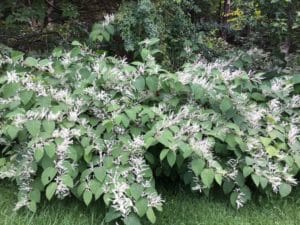
Japanese Knotweed is attractive to pollinators in Fall.
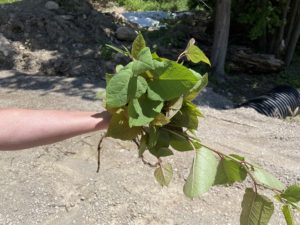
Knotweed’s damaging roots run deep.
Knotweed, though shrublike, is not woody. It’s a hefty herbaceous perennial in the buckwheat family. Its stems are hollow and look like bamboo, growing ten to thirteen feet.
The showy, lacy white flowers cover the colonizing plants from late Summer into Fall. Pollinators such as honeybees adore the plethora of plumes when not much else is blooming — the buzz catching the attention of passersby. Home beekeepers also make good use of the invader by cutting the hollow stems and bundling them as habitat for solitary, tunnel-nesting native bees.
After visiting Susan, Jolee put on the brakes to lounge in the sun next to a beautiful patch of Crown Vetch. Sporting lovely pinkish-lavender clover-like flowers from May through August, pollinators also adore them.
Isn’t it interesting what we once adore becomes dreaded?
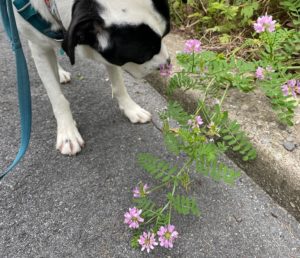
Jolee stops to admire Crown Vetch.
Native to Europe, Asia, and Africa, Crown Vetch (Coronilla varia) was brought to the United States in the mid-1800s. By the 1950s, it had become a popular groundcover for stabilizing slopes along roadways and waterways. This herbaceous perennial from the legume family also served as a cover crop. Its trailing, dark-green foliage grows two to six feet long. And it’s adaptable to all kinds of soil. It prefers open, sunny spots and tolerates drought, with aggressive rhizomes that spread up to ten feet horizontally. Now it’s reportedly invasive in many states.
Crown Vetch suppresses and overshadows other plants, creating a thick monoculture (a single plant or crop in a given area), robbing the soil of nutrients. Nature needs a diverse assortment of plants to support wildlife and encourage natural checks and balances against pests and diseases. It’s what’s inspiring many farmers to return to growing multiple crops.
Controlling Crown Vetch is challenging. While continually mowing prevents it from going to seed, herbicides (sadly) are likely needed to kill the plant. Or controlled burns (better) following regulations.
Birdsfoot is a close cousin to Crown Vetch.
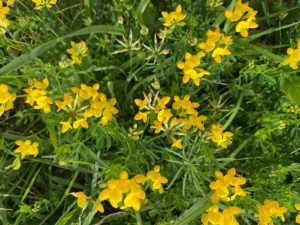
The dry seed heads of Birdsfoot trefoil that look like birds’ feet
Birdsfoot trefoil (Lotus corniculatus) is also decorating the sides of the road this time of year—a yellow-flowering close cousin to Crown Vetch. Its common name comes from the dry seed heads that look like birds’ feet. Used as forage for livestock and erosion control, it’s now also considered invasive in many parts of North America and Australia.
According to The Native Plant Society of NJ, Crown Vetch is in the ‘Strongly Invasive and Widespread Category 1’ listings, along with Japanese Knotweed and many other plants. But I didn’t find Birdsfoot trefoil on the list. (Invasive.org has Regional and State lists you can access to check your neck of the woods – link below.)
Native alternatives to securing slopes
The Pennsylvania Department of Conservation and Natural Resources suggests an assortment of warm-season native grasses to secure slopes instead of Crown Fetch. There’s Big Bluestem (Andropogon gerardii), Little Bluestem (Schizachyrium scoparium), and Indian Grass (Sorghastrum nutans). Also, if you prefer a legume family plant, Partridge Pea (Cassia fasciculata) or Round-headed Bush Clover (Lespedeza capitata) are excellent choices. Music to my ears as I adore these beauties planted in swaths or amongst a meadow.
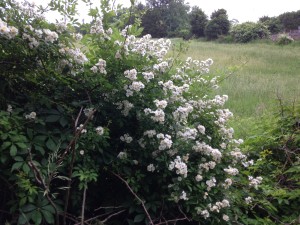
Multiflora Rose
Initially spread by intentional planting, Crown Vetch and Birdsfoot began moving on their own with the help of deer and other critters, dispersing their seeds. I can’t blame a plant for that. But now what was good is bad, like many plants we’ve chatted about over the years, such as Multiflora Rose brought here as a hardy rootstock to propagate roses and Japanese Barberry taking over forest floors. Maybe someday, deer will learn to eat them. After all, they can chomp the heck out of the equally prickly varieties of roses we plant in our gardens.
Garden Dilemmas? AskMaryStone@gmail.com (and on your favorite Podcast App.)
There’s more to this story in Episode 62 of the Garden Dilemmas Podcast:
Link to a related story: September Roadside Beauties
Helpful Links:
The Native Plant Society of New Jersey
The Pennsylvania Department of Conservation and Natural Resources
More about Controlling Crown Vetch


