


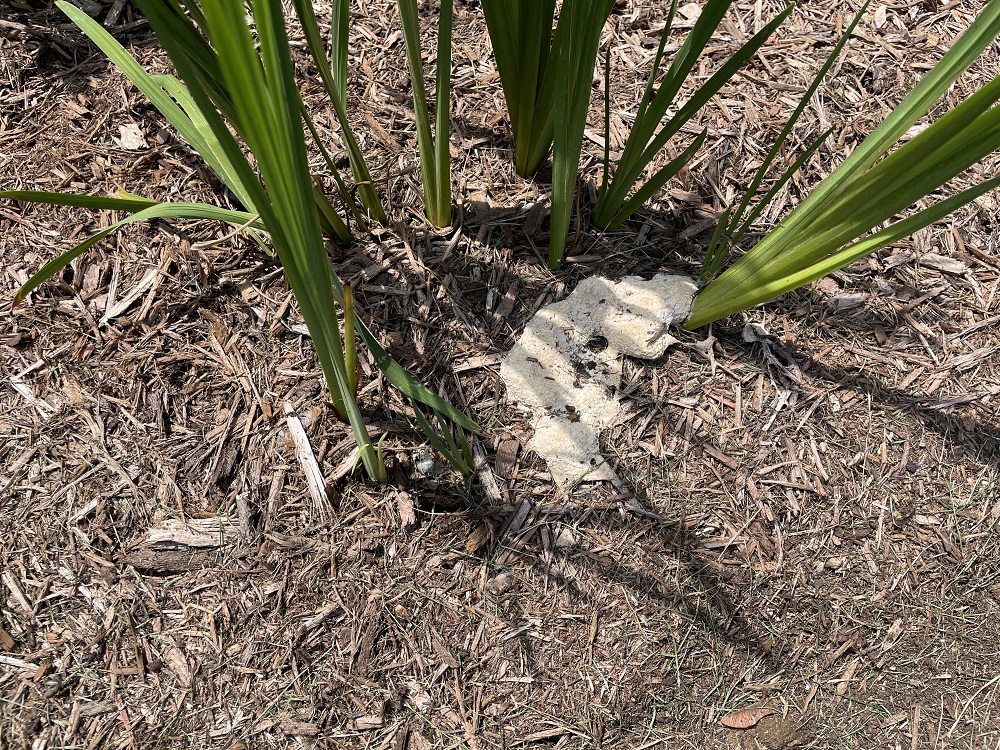
Hello, fellow readers. Several fungal dilemmas have been emerging as of late. Bob of Piscataway, NJ, sent a photo of icky, creamy, frothy stuff on Hakonechloa. Also known as Japanese Forest Grass, it’s one of my favorite shade-loving ornamental grasses. It’s the first time I’ve seen slime mold on a plant. Another dilemma I came upon was the dreaded artillery fungus on recently installed cedar mulch.
The Mysteries of Slime Mold
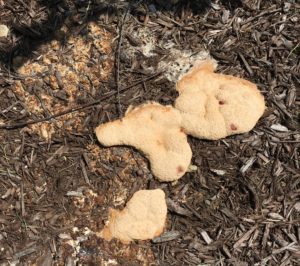
Slime Mold is typically found growing on mulch during periods of excessive moisture.
Typically, slime mold can show up on mulch during excessive moisture and humidity, such as we’ve had. “It appeared overnight,” Bob writes, “Do you think I should do anything about it”?
To which I replied, “Well, well, well, that is pretty disgusting! Good thing I’m not having breakfast. I call it cat yak; others say dog hurl (hope you’re not having lunch.) I’ve never seen it form on plants, though.”
I suggested they cut the affected foliage along with the fungus, toss it into a plastic bag, and throw it in the trash to prevent spread.
It turns out I may have spoken too soon, as slime mold rarely affects grasses, per the Alabama Extension cooperative. The article references slime mold on turfgrass that appears after extended rain, heat, and humidity when the blades remain wet. Logically, low-growing Japanese Forest Grass is an appealing host as well.
The harmless “primitive saprophytic fungi” only use leaf blades as a structure on which to grow. It feeds on decaying organic matter in the soil or thatch in lawns. As in the case of Bob’s fungi, the foamy whiteish-yellow colored fruiting bodies (it can also be purple, grey, or orange) lie on top or amongst the black or dark brown mass of powdery spores.
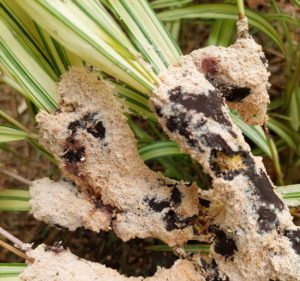
News to me, slime mold can also form on plants.
A strong stream of water will wash the slime off. Or leave well enough alone, the Alabama Extension Cooperative advises. It will disintegrate, leaving no trace of evidence and causing no damage to the plant.
I felt a bit better coaching Bob to cut the fungi-ridden foliage after reading the Ohio State University extension office’s note—slime mold could affect a plant’s vitality if it persists, inhibiting photosynthesis. And, it can occur in the same area year after year.
The dreaded Artillery Fungus
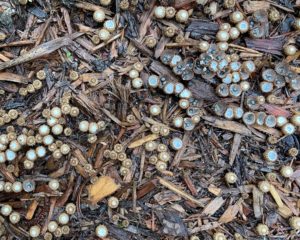
I mistakenly thought this was Artillery Fungus, but a kind reader identified it as Bird’s Nest Fungus -Nothing to worry about in the mulch, as it readily breaks down.
Speaking of which, I was sad to see artillery fungus in a recently renovated garden. Cedar mulch is more resistant to fungus, which is what we installed only two months ago. It was early enough to remedy. We skimmed off the spores, tossing them into the trash for good riddance. In the future, periodically stirring up the wood mulch and freshening it with an inch of new layer each year helps prevent any fungus from forming.
Artillery fungus looks like clusters of tiny orange-brown or cream cups. Their minute black specked centers shoot tar-like spores towards the sunlight, which is why light-colored houses and cars are more vulnerable to the sticky stuff.
Mulch is often to blame. However, it can originate in nearby decaying forest trees, rotting leaves, or deer and rabbit droppings, which can quickly infect newly laid mulch. It’s tough, if not impossible, to remove, but Simple Green All-Purpose Cleaner seems to do the trick.
The best mulch to deter fungus?
Penn State Extension Office tested 27 mulches and determined that the large pine bark nuggets are the most resistant. Bark mulch stays dryer and firmer than traditional wood mulch. Soft and damp is what sets the stage for an artillery fungus attack. Dyed mulches didn’t fare well in deterring fungi, never mind the negative impact of the dye on plant health.
Let’s not forget that fungus serves an important role. Along with bacteria, it breaks down organic matter, which releases oxygen, nitrogen, carbon, and phosphorus into the soil and the atmosphere. And we enjoy the fascinating function of fungi in making bread, wine, beer, and cheese. But in the garden, he’s not a fun guy—couldn’t resist— :^).
Garden Dilemmas? AskMaryStone@gmail.com (and your favorite Podcast App.)
Rather than mulch, why not Plant Mulch Alternatives
Column updated March 4, 2026


Your photo looks like Bird’s Nest Fungus to me rather than artillery.
Worth checking?
Thank you Guy! I made the correction. We all have much to learn in the garden of life, thank you for sharing your knowledge! Mary Stone