


Hello, fellow lovers of all things green,
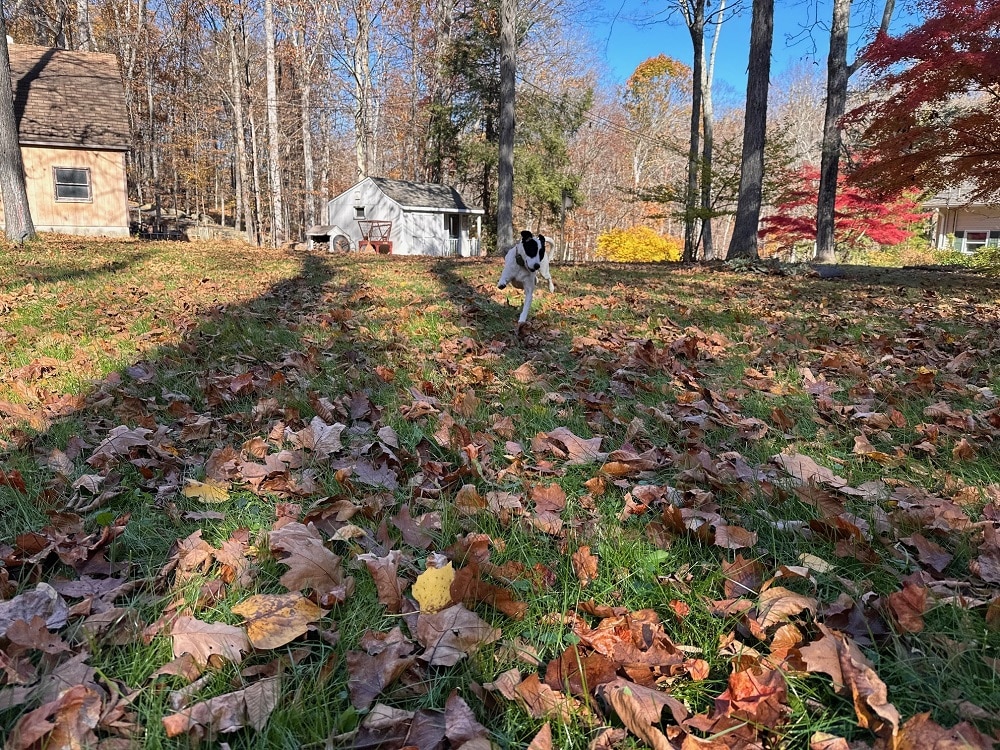
I have a bit of a lawn dilemma. Or, better said, uncertainty about best practices as trees complete their final shedding.
I should preface this by saying I’m not a lawn enthusiast and prefer lawn alternatives where practical, especially when grassy areas aren’t needed for children or canine kids to play. Converting portions of larger lawns to meadows is another option that’s kind to pollinators and pocketbooks, since it reduces lawn maintenance costs. And meadows are lovely!

English Daisies mixed with clover in this lawn alternative are sure to bring a smile.
Speaking of lawn alternatives, I shared the delightful story of Linda and Jim, who traded their traditional lawn for a flowering clover lawn after moving from Los Angeles to Bergen County, New Jersey. Their beautiful alternative even stirred up a little neighborhood controversy! You can read about their experience in Delightful No-Mow Clover Lawns.
Nature’s Way of Cleaning Up
Last year’s leaf cleanup didn’t happen until early spring. Construction of a boulder wall and front walkway was underway during leaf season, with heavy equipment traveling across the lawn to retrieve boulders from the woods. Leaves settled wherever Mother Nature placed them, including disturbed areas awaiting repair. That made me happy.
Come spring, I gathered the heaviest pockets and dragged them into the woods, spreading them over areas disturbed by machinery to help heal the forest floor. I wasn’t removing leaves from the property. I was redistributing them, allowing their nutrients to return to the earth where they were needed.
While walking Jolee the other day, I admired my friend Susan’s immaculate garden. Not a weed in sight! She was tending to leaves when I mentioned that, by and large, mine had taken care of themselves last year.
“Nature has a way of taking care of things if we can handle the mess,” she said.
Indeed! But I don’t see a mess when leaves blanket the ground; I see bundles of nutrients waiting for their next role.
Vitamin-Packed Leaf Confetti

Today’s fluffy mountain of leaves will settle into tomorrow’s garden treasure—nutrient-rich leaf mold.
Think of leaves as vitamin-packed confetti. Trees draw nutrients from the earth, and as their fallen leaves decompose, they return valuable nutrients to the soil.
Shredded leaves make excellent mulch around garden plants, helping retain moisture, moderating soil temperatures, and suppressing weeds. Mowing over a light covering of leaves also returns nutrients to the lawn.
But when leaves accumulate too thickly, especially over traditional turfgrass, they can block sunlight and air, encouraging the grass beneath to deteriorate. That’s where a bit of leaf cleanup comes in.
My shagbark hickories have dropped leaves so thickly that mowing over them isn’t practical. So I’ve been raking and dragging tarps of leaves to areas where I want to suppress weeds, creating spots where my next batch of leaf mold can develop.
Leaf mold is far better than mulch, in my book!

My raking efforts became Jolee and Boohickles’ playground. So much for keeping the leaves in one place! :^)
Raking is remarkably therapeutic and much quieter than using a blower. There’s something satisfying about the rhythm of the rake moving through the leaves and the fresh autumn air. Having Boohickles, Jolee’s boyfriend, gallivanting with her through the leaf piles added to the fun.
Behind the potting shed, I’ve accumulated quite a pile of light, fluffy leaves, easier to tote than heavy, wet ones. As rain softens them, they’ll settle considerably. I’ll redistribute them as needed, keeping them away from tree trunks and crowns to prevent moisture-related disease and insect problems.

A pickerel frog reminds us that autumn’s leafy blanket shelters important garden visitors.
And speaking of treasures hiding beneath the leaves, a beautiful pickerel frog emerged as I raked. What a delightful surprise! Another reminder that what looks like a messy garden to us can be a welcoming habitat for the creatures who share it.
Leaving Seed Heads for Wildlife
The same philosophy applies to spent perennials. Rather than cutting everything down, I leave dried seed heads and stems standing, providing winter food for birds and shelter for beneficial insects.

Dennis’s gift of seeds brought months of color—and Jolee enjoyed exploring the results.
This year, my front garden overflowed with zinnias, thanks to my birder buddy Dennis, who shared seeds harvested from his butterfly garden. Those long-lasting blooms were a gift as the garden recovered from construction. A tradition I’ll continue.
I’ll scatter dried seed heads where I’d welcome another colorful display. Zinnias can self-seed, though Mother Nature may surprise us with different colors.
Black-eyed Susans are another favorite. I affectionately call them Rude Becky, after their botanical name, Rudbeckia. They’re ambitious spreaders, but that’s easy enough to remedy. All you have to do is redirect their enthusiasm by weeding them out.
My Final Lawn Mowing Dilemma
But here’s my dilemma.

The grass is getting shaggy, and the leaves are settling in. Is one last mowing really necessary?
After weeks without mowing, my lawn is shaggy, which is fine by me. Could I leave it until spring? Wouldn’t the dormant grass decay and provide nutrients too?
However, I learned that one final trim after clearing the heaviest leaves helps prevent long grass from matting and reduces the risk of snow mold, a fungal disease that can develop under snow.
And so, a final cut at three inches high or so is my plan. That is, if I can fit it in before the snow flies. If not, I’ll trust Mother Nature to work things out and won’t fret over the possibility of snow mold. By the way, I see people scalping their lawns before winter. Please don’t do that. Cutting grass too short can stress the lawn you’re trying to nurture.
Working with nature doesn’t mean doing nothing; it means recognizing when our help is useful and when it’s better to let things unfold.
Getting Unstuck in the Garden of Life
This first season of maintaining the lawn myself has brought surprising satisfaction. True, I’ve gotten the tractor stuck a few times, which has been stressful. But on a wing and a prayer (literally, I prayed), I managed to get unstuck. Smiling as I write, the same is happening in my personal life. Slow but steady. I’m so grateful.
I’ve also become more intimately acquainted with the property’s nooks, crannies, and problem spots—which are really opportunities waiting to unfold. I’ve learned where the ground is often wet due to an underground spring, and where Mother Nature may have a better planting idea than I originally envisioned.

Jolee doesn’t mind the shaggy lawn one bit. There’s joy in letting things be.
It’s remarkable how caring for a landscape teaches us to pay attention and how those lessons relate to our personal lives. Sometimes we work so hard to manage every outcome, put everything in order, and clear away anything that looks imperfect. But nature doesn’t operate that way.
A fallen leaf becomes nourishment. A spent flower becomes a source of seeds. An untidy corner of the garden becomes shelter for creatures preparing for winter. And an unwanted challenge may lead us toward something beautiful we hadn’t imagined.
That’s autumn’s greatest lesson.
We don’t have to manage everything perfectly or tidy every corner. A little messiness is kinder to wildlife and ourselves.
In our gardens of life, beauty lies in letting things be.
Garden Dilemmas? AskMaryStone@gmail.com or tune in on your favorite podcast app.
Prefer to listen? 🎧
Join me for Episode 274, The Beauty of Leaving Things Be — Lawn and Leaf Dilemmas, on the Garden Dilemmas, Delights & Discoveries Podcast:
Related stories and podcasts:
Vitamin-Packed Leaf Confetti – Blog post
Delightful No-Mow Clover Lawns – Blog post about Linda and Jim’s flowering lawn alternative
Also featured in Podcast Episode 168. Pollinators Love No-Mow Clover Lawns
Podcast Episode 101 also featured in Woodcock Dance – Making a Meadow – Blog Post
Podcast Episode 103 – No Mow May and Marvelous Moss — also featured in: No Mow May Helps Pollinators – Blog post


